Anghiari
A fortified hill town above the upper Tiber valley, Anghiari pairs honey-coloured medieval streets with an outsized place in art history: the battle fought at its walls in 1440 became the subject of Leonardo’s most famous lost painting. Museums, ramparts, and a steeply sloping main square make it one of eastern Tuscany’s essential stops.
Why visit
Anghiari delivers everything travellers hope for in a Tuscan borgo — ramparts, towers, layered palazzi, and views across the Tiber valley toward Sansepolcro — with a narrative thread most towns lack. Its municipality describes it as a suggestive fortified village looking over the northern Tiber valley, and the description is literal: the town keeps its medieval walls and gates, and its museums preserve both the arts and the military story of the borderland where Tuscany met Urbino and the Papal States. It belongs to the Borghi più Belli d’Italia network, holds the Touring Club’s Orange Flag, and sits within the slow-food-minded CittàSlow network. Come for half a day and stay for dinner.
The town also sits inside one of central Italy’s richest art corridors. Piero della Francesca was born across the valley, and the altarpieces and devotional panels that moved through Anghiari’s churches connect the borgo to the broader Renaissance of the upper Tiber; the state collections in Palazzo Taglieschi gather exactly such material, from painted furnishings to sculpture, in a palace of staircases and frescoed rooms. Walkers extend the visit onto the lanes of the Borghetto quarter and the belvedere above the valley, where the battlefield plain reads plainly from the walls.
Character and history
The town’s fame rests on 29 June 1440, when Florentine forces defeated Milanese troops in the plain below — a short, almost bloodless engagement with an outsized legacy. Two decades later Leonardo da Vinci was commissioned to paint the Battle of Anghiari for the Palazzo Vecchio in Florence; he abandoned the work, his experimental technique failed, and the fresco vanished beneath later walls, yet copies by Rubens and others kept the image alive. Anghiari has never let the story go: the Museo della Battaglia e di Anghiari, in Palazzo del Marzocco, keeps the memory of the event and of Leonardo’s unfinished painting.
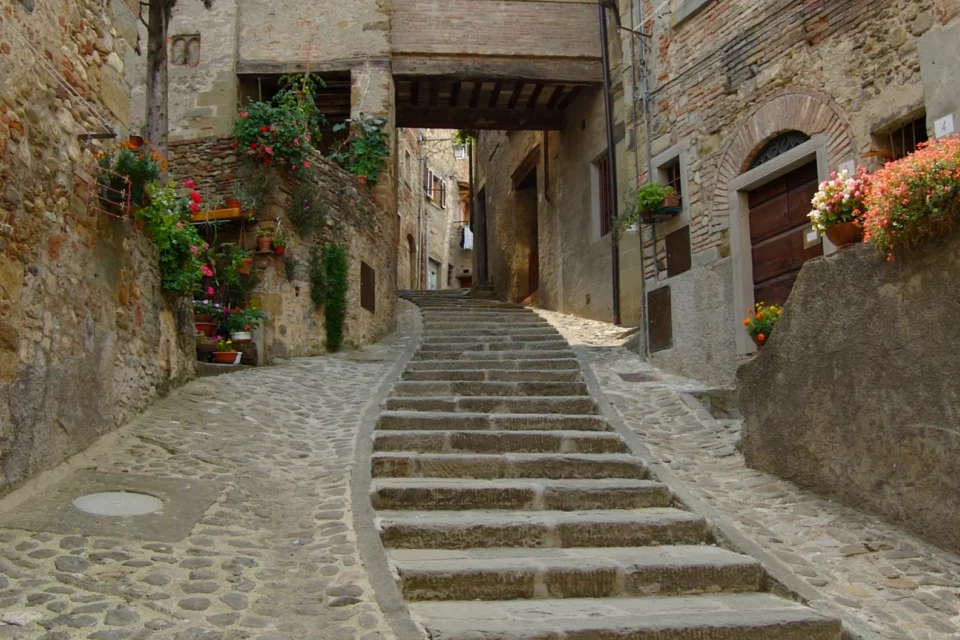
The borgo itself grew as a fortified outpost of the Camaldolese and later Florence, its stone houses packed inside the walls along lanes that climb from the leaning cobbles of Piazza del Popolo toward the fortress at the top of the ridge. The Borghetto quarter holds Palazzo Taglieschi, while the late-eighteenth-century Propositura of Santa Maria delle Grazie, attributed to Giovanni Battista Bellini, gives the town its neoclassical parish landmark.
What to see
Start on Piazza del Popolo, the sloping medieval square lined with porticoes, then work outward: the fourteenth-century Palazzo Pretorio, the Museum of the Battle and of Anghiari in Palazzo del Marzocco with its mechanised reconstructions and studies of Leonardo’s lost work, and the state collections of the Palazzo Taglieschi museum, which preserves popular arts and traditions of the upper Tiber valley. The Church of Santa Maria delle Grazie, the earlier Santo Stefano, and the convent-side Misericordia museum fill out the sacred itinerary, while the town walls offer a perimeter walk with valley views.
How to experience
Give Anghiari the unhurried treatment it rewards. Enter on foot from the car parks below and climb through the gates as the medieval layout intends, pausing at the Belvedere over the Tiber valley. Craft traditions remain live — woodworking, restored textiles, and ceramics — and the shops are working ateliers rather than souvenir stalls. Time a visit to late June, when the town marks the anniversary of the battle, or to winter, when the streets belong to residents. Pair the town with the woodlands of the Casentino or the antique tables of Sansepolcro across the valley.
Practical planning
Anghiari lies in the province of Arezzo, about half an hour’s drive from Arezzo city and the A1 motorway, with the nearest rail connection at Arezzo and a bus link up the valley. Cars stay outside the walls; the walk up is short but steep, so wear sensible shoes. Museums keep different closing days and follow seasonal schedules, so confirm opening times locally before committing an itinerary to them. Restaurants serve hearty upper-Tiber fare — hand-rolled pici, game, and chianina beef — and booking is wise on summer weekends. Spring and autumn bring the clearest valley views.
Nearby places
The valley continues with Sansepolcro, home of Piero della Francesca, the castle village of Poppi in the Casentino, and the Etruscan streets of Cortona to the south, all within easy drives.
Worth building a day around.
Chiesa di Santa Maria delle Grazie (la Propositura)
Scheda del Catalogo Generale dei Beni Culturali (MiC) per l'identità; Visit Tuscany documenta la visita: costruita 1628-1740, conserva la Madonna delle Grazie di Andrea…
Chiesa di Santo Stefano
Scheda ufficiale BeWeB (CEI) per l'identità; Visit Tuscany documenta la visita: edificio in laterizio VII-VIII secolo con caratteri bizantino-ravennati e pala quattrocentesca di Domenico…
Mura di Anghiari (borgo fortificato)
Il Comune e il portale Valtiberina descrivono Anghiari come borgo collinare fortificato (Borghi più belli d'Italia, Bandiera Arancione) con cinta muraria percorribile; esperienza pubblica…
Museo della Battaglia e di Anghiari
Pagina ufficiale del Comune di Anghiari dedicata al museo; Visit Tuscany documenta apertura al pubblico, reperti preromani/romani, sezione sulla battaglia del 1440 e sull'affresco…
Museo della Misericordia
Visit Tuscany ('tre musei di Anghiari'): ospitato nell'antico edificio di Badia, conserva oggetti e documenti della Confraternita e cimeli dell'Ospedale della Misericordia fondato nel…
Museo Statale di Palazzo Taglieschi
Pagina ufficiale del Comune; Visit Tuscany documenta il museo statale nel palazzo rinascimentale con Madonna col Bambino di Jacopo della Quercia (c. 1420), affreschi…
Palazzo Pretorio
Visit Tuscany: sede del Comune visitabile, facciata a L con stemmi dei vicari fiorentini, carceri, Giustizia di Antonio di Anghiari (XV sec.), cappella del…
Piazza del Popolo
Cuore del borgo fortificato, indicato dal portale ufficiale meetvaltiberina e dal Comune come spazio pubblico centrale della visita. Spazio pedonale su pendenza.
Journeys in Anghiari.
Demo — Anghiari Private Highlights Tour
Let a local expert design your Anghiari day.
Tell us your dates and pace. A travel designer replies within one working day.