Ancona
Ancona bends like an elbow around one of the Adriatic’s great natural harbours, a hill city of Greek, Roman, medieval and papal layers crowned by a cathedral on the water’s edge. Capital of the Marche, it pairs working-port energy with Roman marbles, a pentagonal eighteenth-century lazaretto and beaches at the city’s back door.
Why visit
Travellers who board ferries in Ancona often leave without knowing what they passed. The city deserves better: it is a place where you can stand under a white marble Roman triumphal arch, climb to a romanesque cathedral whose dome watches over the harbour, and then walk to a seventeenth-century church on a beach south of town — all within a day. Ancona’s setting is its argument: a city of hills run down to the sea on a promontory that shelters one of the finest natural ports of the Adriatic, unique in Italy for letting you watch both sunrise and sunset over the water. The centre is dense and walkable, threaded with itineraries the municipality maintains — Ancona through the centuries, Jewish Ancona, underground Ancona — and the coast at Passetto and Portonovo supplies rocky coves and pebble beaches minutes from the piazze. For visitors bound for the Conero riviera or Greece, this is the natural stopover; for anyone interested in ports as engines of history, it is a destination in its own right.
Character and history
The Greeks gave Ancona its shape and its name: settlers from Syracuse arrived around 387 BC, calling the place Ankon — elbow — for the hooked promontory that shelters the harbour, and the “Doric city” still mints civic pride from that lineage. Rome enlarged the port under Trajan with his engineer Apollodorus of Damascus, and the Senate’s marble arch of 115, rising about eighteen metres at the harbour mouth, appears carved on Trajan’s Column in Rome. After Byzantine times and Saracen raids, the city grew into an independent maritime republic that struck its own agontano coinage and beat off imperial sieges — the siege of 1174 is remembered through the heroine Stamira — before falling to the Papal States in 1532. Papal Ancona boomed as a free port under Clement XII: the lazaretto built between 1733 and 1743 by Luigi Vanvitelli on an artificial island in the harbour is the monument to that era. The city’s Jewish community, tolerated here when expelled elsewhere, gave it one of Italy’s enduring historic quarters. Bombarded in 1915 and taken by the Polish 2nd Corps in July 1944, Ancona rebuilt into the Adriatic’s ferry gateway — pragmatic, layered, unsentimental.
What to see
Start high at the Ancona Cathedral (San Ciriaco) on Colle Guasco, a grey-stone romanesque church on a Greek-cross plan, consecrated in the early eleventh century and completed in 1189, with a dodecagonal dome and ten columns said to come from a Roman temple. Below the hill lie the Roman Amphitheatre of Ancona, Augustan in date and overlooking the ancient city, and the Arch of Trajan at the harbour’s south mole.
The waterfront’s centrepiece is the Mole Vanvitelliana (Lazzaretto of Ancona), Vanvitelli’s pentagonal quarantine island with a temple of San Rocco at its heart — now a venue for exhibitions, concerts and cinema, and home since 1993 to the Omero State Tactile Museum, where art is read by hand.
In the historic centre, visit the Church of Santa Maria della Piazza with its Romanesque facade, the Loggia dei Mercanti, the Piazza del Plebiscito with Cornacchini’s statue of Clement XII, the Francesco Podesti Civic Art Gallery, the National Archaeological Museum of the Marches in Palazzo Ferretti, the baroque double-faced Porta Pia, the Teatro delle Muse and the Ancona Citadel. South along the coast stands the eleventh-century Church of Santa Maria di Portonovo, and on the Passetto rocks the Passetto War Memorial faces the open sea.
How to experience
Climb to San Ciriaco late in the afternoon, when the harbour glitters and the dome’s profile does its best work, then descend through the lanes of the old centre to the seafront. Take a guided visit of the amphitheatre when the municipality’s seasonal openings run, and give the Mole Vanvitelliana an unhurried hour — its geometry is best read from the bridges, its Omero museum is unlike any other in Italy, and its summer programme often earns an evening return. Use the city as a base for the coast: swim below the Passetto cliffs, then continue to Portonovo for the church, the bay and a seafood lunch on the water. The municipality’s themed itineraries — Grand Tour Vanvitelliano, Jewish Ancona, the twentieth-century trail — are free frameworks that impose order on a layered centre. Time a visit around the September Festival della Storia or Festa del Mare if you can.
Practical planning
Ancona is the capital of the Marche, on the Adriatic about 280 km northeast of Rome, with its own airport at Falconara, a main railway station on the Bologna–Lecce line, and the Adriatic’s principal ferry port for Greece and Croatia. The historic centre sits between the port and the hills — steep in places, so plan routes around the Guasco climb. City buses reach the Passetto and Portonovo in season; the Conero coast is a short drive south. Museums and monuments keep mixed weekly schedules, and the amphitheatre opens for guided visits only — check anconatourism.it and comuneancona.it before travelling. Late spring and September suit walkers best; July and August bring beach crowds to Portonovo and Mezzavalle. Non-slip shoes serve well on the Passetto rocks.
Nearby places
South along the Conero coast lie Numana and Sirolo, the Riviera’s twin seaside towns gathered under the Conero Riviera banner. Inland and north in the same province are the medieval centres of Jesi, Corinaldo and Senigallia, with Loreto, Italy’s great Marian shrine, just up the valley.
Worth building a day around.
Anfiteatro Romano di Ancona
Scheda ufficiale nella sezione Monumenti del Comune di Ancona. Modalità di visita attuali non dettagliate nella pagina: left unknown. Area archeologica tra Colle Guasco…
Arco di Traiano
Scheda ufficiale nella sezione Monumenti e Palazzi Storici del Comune di Ancona: monumento romano sul porto, liberamente visibile. Area pedonale del molo; visitabile liberamente…
Cattedrale di San Ciriaco
Chiesa catalogata nella sezione ufficiale Chiese del portale turistico comunale Ancona Tourism; cattedrale della diocesi di Ancona-Osimo, aperta al pubblico. Sul colle Guasco; accesso…
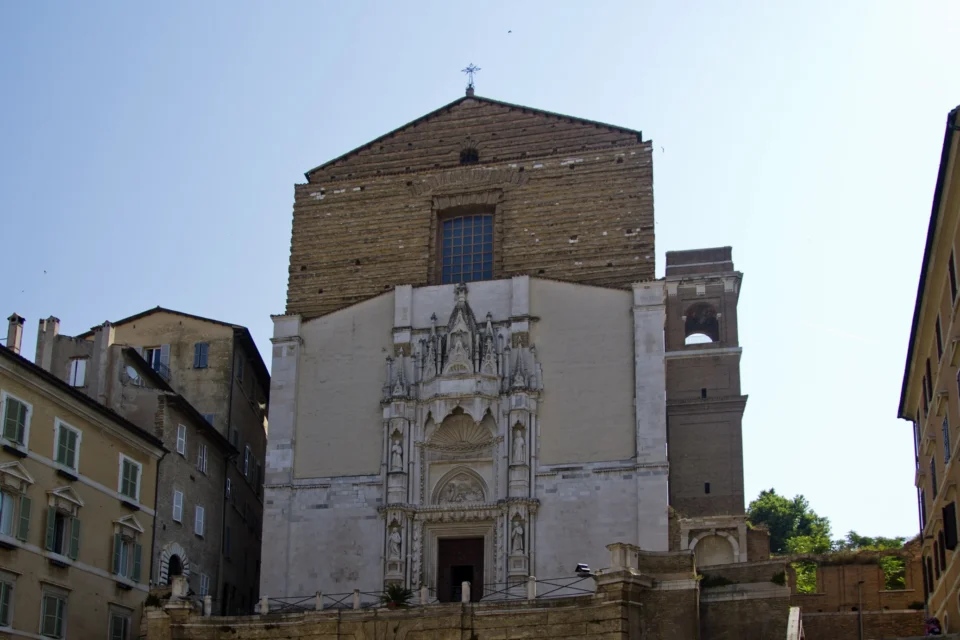
Chiesa di San Domenico
Catalogata nella sezione ufficiale Chiese di Ancona Tourism. Chiesa storica nel centro.
Chiesa di Santa Maria della Piazza
Catalogata nella sezione ufficiale Chiese di Ancona Tourism. Facciata romanica visitabile dalla piazza.
Chiesa di Santa Maria di Portonovo
Catalogata nella sezione ufficiale Chiese di Ancona Tourism; apertura stagionale gestita localmente. Nella baia di Portonovo sul Monte Conero.
Cittadella di Ancona (Fortezza del Sangallo)
Elencata tra i luoghi del portale ufficiale Ancona Tourism; uso militare parziale, visitabile esternamente. Area esterna e spazi panoramici visitabili.
Loggia dei Mercanti
Monumento catalogato tra i beni della città sul portale comunale; sede storica della Camera di Commercio affacciata sul porto. Facciata visitabile dalla via.
Mole Vanvitelliana
Scheda ufficiale Ancona Tourism: edificio aperto con mostre, eventi, visite guidate alla marciaronda e al Lazzabaretto; ospita il Museo Omero. Isola artificiale pentagonale nel…
Monumento ai Caduti del Passetto
Area del Passetto con grotte e monumento elencata tra i luoghi del portale ufficiale Ancona Tourism. Area panoramica sul mare; interno aperto solo in…
Museo Archeologico Nazionale delle Marche
Istituto MiC (Musei Nazionali Marche) con sede a Palazzo Ferretti; biglietto intero 6 euro, ridotto 3 euro secondo scheda istituzionale regionale. Palazzo storico; verifica…
Museo Tattile Statale Omero
The main Omero collection is free; the Design collection costs €5, with free entry on the first Sunday of the month. Normal hours are…
Piazza del Plebiscito
Scheda ufficiale Comune di Ancona: ex Piazza Nuova/Piazza Grande, sede del Palazzo del Governo, spazio pubblico storico. Spazio pubblico pedonale.
Pinacoteca Civica Francesco Podesti
Pagina ufficiale del Comune: mar-gio 16-19, ven 14-19, sab-dom 10-13 e 16-19; biglietto intero 8 euro, ridotto 5 euro, gratuite previste. Riaperta il 6…
Porta Pia
Scheda ufficiale Comune di Ancona: porta con doppia facciata barocca. Monumento urbano visitabile dall'esterno.
Teatro delle Muse
Portali istituzionali della gestione (Fondazione Teatro delle Muse / Marche Teatro) con stagione 2026-27 e biglietteria attiva. Teatro principale regionale; biglietteria in Via della…
Journeys in Ancona.
Demo — Ancona Private Highlights Tour
Let a local expert design your Ancona day.
Tell us your dates and pace. A travel designer replies within one working day.