Anacapri
Anacapri sits on the quiet high shoulder of Capri, a separate town with its own rhythm, its own church of majolica, and the island’s highest summit. It is where Capri goes to breathe: whitewashed lanes, citrus gardens, and the sea always somewhere below.
Why visit
Anacapri rewards travellers who want the island’s drama without its crowds. The town occupies the upper slopes beneath Monte Solaro, and its light is different from the harbour town below: clearer, wider, more open to the sky. Here you can ride a single-seat chairlift to the island’s rooftop, walk through the gardens of a Swedish writer’s dream house, and stand before a floor of eighteenth-century painted tiles that people cross the water to see. The Blue Grotto, that luminous sea cave the Ministry of Culture cares for as an archaeological site, belongs to this municipality too. Anacapri is also simply a place to stay and eat well, away from the day-trip current, among families who have gardened these terraces for generations.
Character and history
For centuries Anacapri lived apart from Capri town, joined to it only by the steep Scala Fenicia stairway of several hundred steps. That separation bred a self-contained mountain community of farmers, shoemakers and fishermen’s wives, and a dialect and calendar of feasts all its own. The town’s ancient roots are imperial: a Roman villa traditionally attributed to Tiberius stands above the Blue Grotto, which in antiquity served as a decorated nymphaeum, its submerged niches once holding statues of Neptune and Tritons recovered by divers in the 1960s and 1970s. In the late nineteenth century the Swedish physician and author Axel Munthe arrived, fell for the light, and built Villa San Michele on the ruins of a Roman residence; his book and his house drew a European intellectual circle to the mountain and began Anacapri’s second life as a place of retreat. The sense of a village that absorbed its fame without being changed by it survives in the evening passeggiata along Via G. Orlandi.
What to see
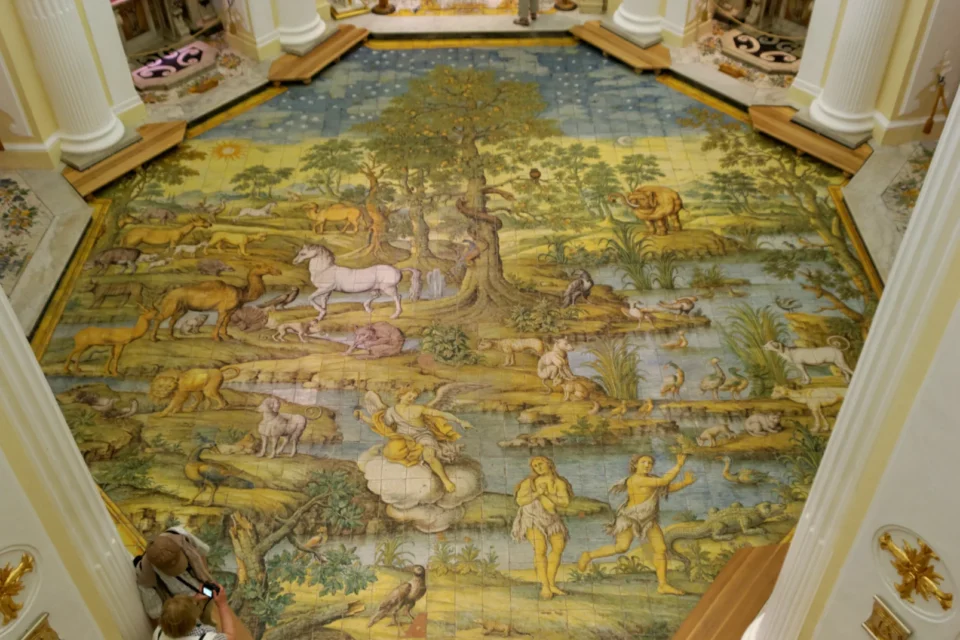
The Church of San Michele Arcangelo keeps one of the most joyful sights in Campania: a vault-wide majolica pavement, laid in the eighteenth century, showing the Garden of Eden with its beasts spreading across the nave. Locals walk a raised gangway around the edge so the picture stays whole. A short climb away, Villa San Michele arrays its loggias, sphinx and terraced gardens over the bay; the Swedish state now cares for it, and the view from the sphinx’s parapet is one of the island’s defining images. From Piazza Vittoria the Monte Solaro Chairlift lifts you in a slow dozen minutes to the summit at 589 metres, where the panorama runs from the Bay of Naples to the Amalfi coastline. Down at the waterline, the Blue Grotto admits small rowing boats through a low mouth into a chamber flooded with unearthly blue light, sunlight filtered through the submerged opening; Roman masonry and the ghosts of that imperial nymphaeum make it more than a natural curiosity.
How to experience
Give Anacapri a full day, or better, several. Ride up early on the chairlift before the queue builds, then walk down through the pine shade if your knees allow. Pair the San Michele pavement with a slow visit to Villa San Michele’s gardens, and take lunch in town on a quiet side street rather than the main square. For the Blue Grotto, check sea conditions first: entry depends on calm water and the small boats only run in the right swell, so look at the official information from the Ministry of Culture (cultura.gov.it) or ask at the ticket point in the morning. Books and quiet matter here too — Munthe’s memoir, The Story of San Michele, reads differently in the place that inspired it.
Practical planning
Anacapri lies about ten to fifteen minutes by bus above Capri town; the Scala Fenicia connects the two on foot for the energetic. Funiculars, buses and the chairlift run to seasonal schedules, so verify current timetables with the island’s official tourism portal (capritourism.com) and the municipality (comune.anacapri.na.it) before travelling. Comfortable shoes are the only essential equipment; the lanes are stepped and the sun strong. The Blue Grotto season and prices change year to year, and the cave closes whenever the sea is rough — build a fallback day. Accommodation in Anacapri tends to be calmer and often better value than by the Marina Grande, and evenings feel like a village rather than a stage set.
Nearby places
Capri town, the island’s harbour and social heart, is a short ride up the hill: Capri. Across the gulf the volcanic arc of the Phlegraean coast and its own ruined antiquity wait: Pozzuoli. The other bay islands make easy day trips by ferry: green Ischia and small, pastel Procida.
Worth building a day around.
Chiesa di San Michele Arcangelo
Official municipal POI page (Comune di Anacapri): baroque church built 1698-1719 at the behest of Mother Serafina di Dio, 'accessibile a tutta la cittadinanza',…
Grotta Azzurra
Advance reservation is optional according to the official site listing. Entry depends on sea and weather conditions; transport and admission arrangements must be checked…
Seggiovia di Monte Solaro
Official operator site capriseggiovia.it announces 'Seggiovia APERTA' with seasonal hours (Feb-Mar-Nov-Dec 9:30-16:00, last descent 16:30; Apr-Oct from 9:15); return EUR 14, single leg EUR…
Villa San Michele
Official site villasanmichele.eu: open as museum and garden with seasonal hours (Jan 9:00-15:30 closed Tue; Feb closed; Mar 9:00-16:30; Apr 9:00-17:00; May 9:00-18:00; Jun-Aug…
Journeys in Anacapri.
Demo — Anacapri Private Highlights Tour
Let a local expert design your Anacapri day.
Tell us your dates and pace. A travel designer replies within one working day.