Amalfi
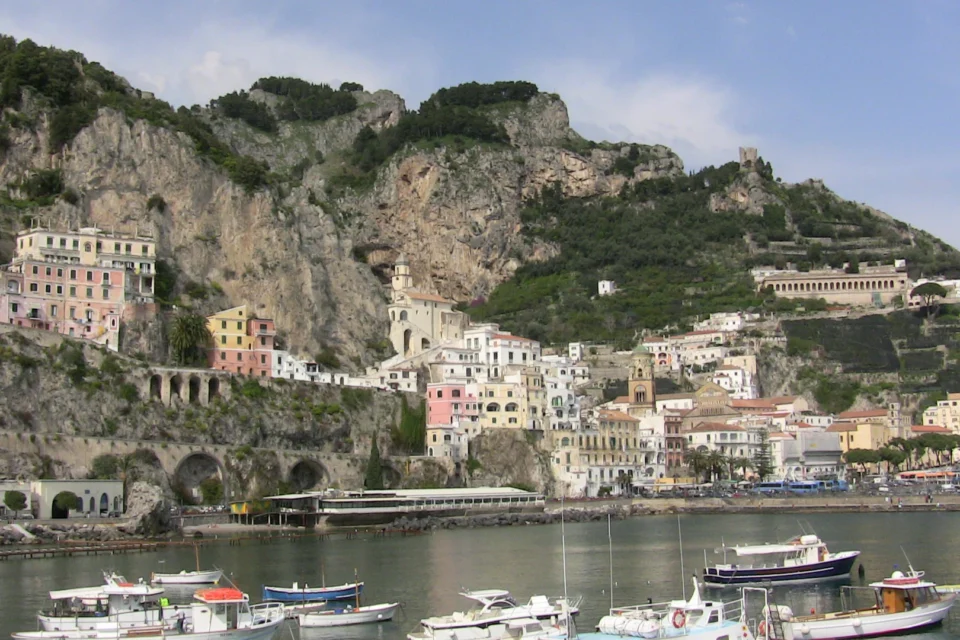
Amalfi gives its name to the whole coast, and it earned that honour a thousand years ago as head of a maritime republic that rivalled Venice and Pisa. Today its striped cathedral, medieval shipyard and paper-making valley make it the most substantial town on the Coast of the Doges — a place to explore as well as to admire.
Why visit
Positano is a picture; Amalfi is a story. Beneath the cliff-hung houses lies the monumental complex of the Cathedral of Sant’Andrea, with its Byzantine bronze doors, Arab-Norman cloister and the crypt of the apostle himself. Around the corner, the Arsenal of the Republic preserves the stone skeleton of the shipyard that armed medieval fleets, and up the valley the Paper Museum keeps alive a craft that Amalfi may have taught to Italy. The town is compact and walkable, threaded by stepped lanes that recall an eastern souk, and it offers the best mix of serious monuments, swimming and food on the coast.
Character and history
Between the ninth and eleventh centuries Amalfi was the most prosperous city of southern Italy’s Tyrrhenian shore — an emporium whose traders kept warehouses in Palermo, Messina, Syria and Palestine. Arab chroniclers praised its wealth, and its law code, the Tavole Amalfitane, governed Mediterranean commerce for centuries. That eastern connection is written into the town’s stones: the cathedral’s twelfth-century facade is a striped cascade of interlaced arches, the Cloister of Paradise repeats the same pointed geometry in white, and the bronze doors were cast in Constantinople and donated by the merchant Pantaleone de Comite in 1060.
Amalfi’s second invention was quieter: paper. The maritime republic’s contacts with the Arab world appear to have brought the craft to the mills of the valley behind the town, where Amalfi and Fabriano still contest the primacy of paper-making in Europe. Political eclipse and natural calamities in time shrank the city, but its monuments survived, and today Amalfi is both the historical capital and the civic heart of the coast included in the UNESCO World Heritage Costiera Amalfitana.
What to see
The Monumental Complex of the Cathedral of St Andrew dominates Piazza Duomo. Founded in 987 and rebuilt by Cardinal Pietro Capuano in the early thirteenth century, the cathedral holds a coffered ceiling, an Egyptian granite column pair brought from Paestum, and below the altar the crypt of Sant’Andrea, whose relics have been associated since 1304 with a “manna” venerated by pilgrims. Adjacent, the Cloister of Paradise, commissioned in 1268 as a burial ground for noble families, rings its little garden with interlaced arches, Roman sarcophagi and frescoed chapels; the Cathedral Sacred Art Museum (Basilica of the Crucifix) occupies a ninth-century basilica and displays the diocese’s treasures.
At the seafront stands the Arsenal of the Republic, documented from 1042 and unique in the West as a medieval shipyard retaining its original structure; stone arches shelter the Museum of the Compass and the Maritime Duchy, which recalls Amalfi’s seafaring and navigation traditions. Up the Via delle Cartiere, in a valley once crowded with water-driven mills, the Paper Museum demonstrates handmade paper in a restored mill — the town’s most hands-on experience. For views over the roofs to the sea, climb to the Belvedere San Lorenzo.
How to experience
Arrive by sea if you can — the ferry approach past the towers and the Duomo’s silhouette is the way the republic wanted to be seen. Give the cathedral complex an unhurried morning, including the crypt, then cool off in the Arsenal and the paper valley. Swim at the small town beach or from the lidos beneath the cliffs, and eat away from the piazza: scialatielli with seafood, lemon delights, and the coast’s proverbial sfusato lemons in every form. Time a visit for June for the regatta-year festivities or for the feast of Sant’Andrea, when the statue is carried down to the sea; in winter the town is calm, monuments are quiet, and the lemons are at their best.
Practical planning
Amalfi has no railway: reach it by SITA bus from Salerno or Sorrento, by ferry from Salerno, Positano or Naples in season, or by car — though the SS163 coast road is narrow, congested and best left to buses and ferries in summer. The town fills between late morning and late afternoon with day trippers; stay overnight and you reclaim it at dawn and in the evening. Museum and monument opening times change with the seasons — the cathedral complex in particular follows a calendar that shortens in winter — so check visitamalfi.info and the individual museum sites before travelling. Comfortable shoes are essential: the town is a ladder of stairs.
Nearby places
Amalfi is the perfect hub for the coast’s other towns. Atrani is a ten-minute walk through the tunnel or over the cliff path; Ravello, with its villas and gardens, rides the ridge above; Minori, the ancient Rheginna Minor, serves a gentler seaside rhythm; and Positano, the coast’s most photographed town, lies just around the promontory to the west.
Worth building a day around.
Arsenale della Repubblica
Official site: the only medieval shipyard in the West retaining its original structure, restored and open for visits, events and civil weddings.
Belvedere San Lorenzo
Listed among the official Visit Amalfi points of interest (Sea & Nature section).
Chiostro del Paradiso
Included in the cathedral complex ticket; officially described as a four-sided Arab-Norman portico commissioned in 1268, with sarcophagi and chapels, open to visitors.
Complesso Monumentale della Cattedrale di Sant'Andrea
Official Visit Amalfi page documents the visitable complex: cathedral, crypt with St Andrew's relics, Basilica del Crocifisso (sacred art museum) and Chiostro del Paradiso;…
Museo d'Arte Sacra del Duomo (Basilica del Crocifisso)
Official page lists the Museo Diocesano in the 9th-century Basilica del Crocifisso as part of the visitable complex with a combined ticket.
Museo della Bussola e del Ducato Marinaro
Official Arsenale site states the museum area (Museo della Bussola e del Ducato Marinaro) is hosted inside the Arsenale.
Museo della Carta
Official site: open daily 10:00-19:00 from 1 March; standard, guided and handmade-paper-workshop tickets, on site or online.
Journeys in Amalfi.
Demo — Amalfi Private Highlights Tour
Let a local expert design your Amalfi day.
Tell us your dates and pace. A travel designer replies within one working day.