Alberobello
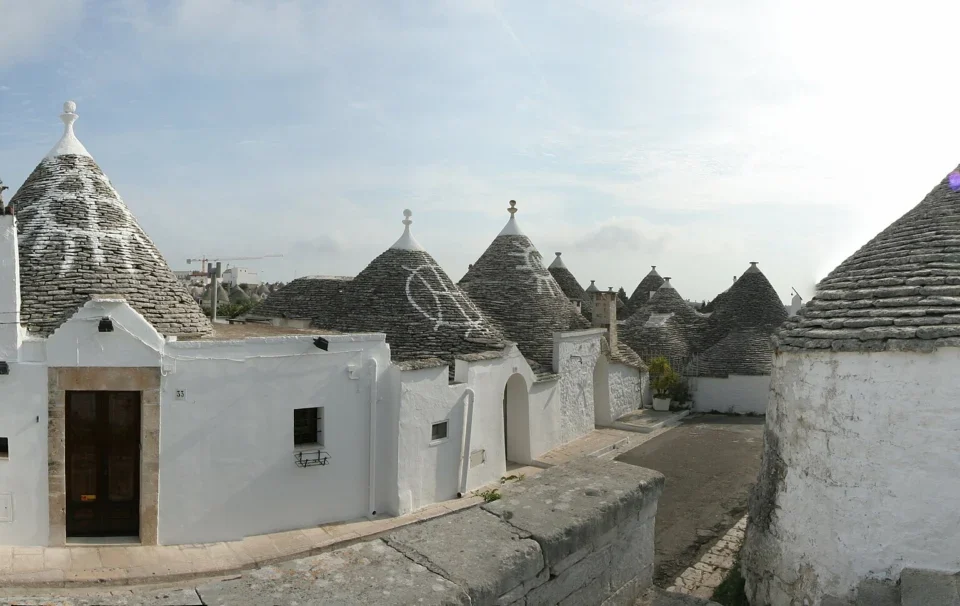
Alberobello is the small Puglian town where an entire historic quarter is built of trulli — whitewashed dry-stone houses crowned with grey conical roofs. Inscribed by UNESCO in 1996, it offers one of Italy’s most singular streetscapes, yet remains compact enough to experience fully on foot in a day or a slow weekend.
Why visit
Few places in Europe look like this. In the Rioni Monti and Aia Piccola districts, more than a thousand cone-roofed houses climb a gentle hillside, their limestone walls and symbolic pinnacles forming a coherent, living piece of folk architecture rather than a reconstructed exhibit. UNESCO inscribed the trulli in 1996 under criteria (iii), (iv) and (v), praising the originality of their form and the way an entire pre-modern building tradition survives in use. You come for the silhouette and the light, but you stay for the texture: narrow lanes, artisan workshops, rooftop terraces and a rhythm of life that continues inside the monuments.
Character and history
Alberobello sits in the Itria Valley, the gentle agricultural plateau between Bari and the southern Salento plain. Settlement began in the early sixteenth century, when the Counts of Conversano moved peasant families onto the land. A fiscal quirk shaped everything that followed: under an edict requiring feudal approval for new towns, the counts obliged their tenants to build without mortar, so dwellings could be classed as provisional and dismantled before any inspection. Dry-stone construction became the town’s signature — thick limestone walls, corbelled domes of overlapping chiancarelle slabs, and a central keystone often pulled to bring the whole roof down in a hurry.
The town escaped its feudal straitjacket in 1797, when King Ferdinand IV declared it a royal city, and its citizens immediately began building in brick and mortar. Paradoxically, that liberation froze the old quarters in their original form, preserving for posterity exactly what the tax authorities once despised. Trullo Sovrano was declared a national monument in 1923 and Rione Monti followed in 1928, decades ahead of the UNESCO listing.
What to see
Start at Trullo Sovrano, the only two-storey trullo ever built, now a house-museum furnished in the style of an early twentieth-century home; its domed interiors show how substantial these “temporary” huts could become. Cross the town past the Basilica of the Holy Doctors Cosmas and Damian, the neoclassical parish church dedicated to Alberobello’s patron healers, whose feast is celebrated in late September. Then give the rest of your time to the Trulli of Alberobello – Rioni Monti and Aia Piccola: Monti is the larger, busier district with roughly a thousand cones whose streets take their names from First World War battlefields, while Aia Piccola, about four hundred cones, remains quietly residential. When the whitewashed lanes tire you, retreat to Selva Woods (Bosco Selva), a municipal woodland on the town’s edge with shaded walking paths and picnic spots.
How to experience
The best hours are early morning and dusk, when the day-trippers thin out and the cones glow against a violet sky. Walk without a route for an hour, then slow down inside one: several trulli operate as museums or craft shops where you can study the corbelling from beneath. Sleep in a trullo at least one night — many family homes in the districts now welcome guests — and eat the valley’s classics, from orecchiette to burrata, at a table under the cones in Largo Martellotta. Cyclists can ride out among vineyards and olive groves to the woods. Visit the tourist information point on Corso Vittorio Emanuele II for current opening times of the house-museums, and check www.alberobello.com for guided tours and events.
Practical planning
Alberobello has a railway station on the Bari–Martina Franca line, with regional trains taking roughly an hour and a half from Bari; driving from Bari airport takes about an hour. Park outside the historic centre — the trulli districts are pedestrian-only — and wear comfortable shoes for the sloping, cobbled lanes. Spring and autumn bring the best light and mildest walking weather; summer days are hot and the midday crowds heavy, so plan interiors and lunch for those hours. Most visitors see the essentials in a day, but an overnight stay lets you own the districts after sunset. Confirm museum hours and prices on the official tourism site before travelling, as they change with the seasons.
Nearby places
The Itria Valley crowds its treasures close together. Locorotondo, a white ring of a town perched on a hill a short train or car ride away, pairs perfectly with Alberobello. Monopoli and Polignano a Mare bring the Adriatic into range for an afternoon of sea air, while the regional capital Bari adds a Norman castle, an old fishermen’s quarter and major transport links. Bitonto, with its fine Romanesque cathedral, lies between the two.
Worth building a day around.
Basilica Minore dei Santi Medici Cosma e Damiano
alberobello.com official tourism portal lists the basilica near Corso Vittorio Emanuele II, south of Trullo Sovrano.
Bosco Selva
alberobello.com official tourism portal: about 40-hectare municipal park with paths, picnic areas and protected flora; one of two SCI sites of the comune.
Trulli di Alberobello – Rioni Monti e Aia Piccola
UNESCO WHC page 787: property comprises Rione Monti (about 1,030 trulli) and Rione Aia Piccola (about 590 trulli); freely walkable inhabited public districts.
Trullo Sovrano
UNESCO property parcel; alberobello.com official tourism portal lists Trullo Sovrano as house-museum with EUR 2 admission.
Journeys in Alberobello.
Demo — Alberobello Private Highlights Tour
Let a local expert design your Alberobello day.
Tell us your dates and pace. A travel designer replies within one working day.