Acireale
Half an hour up the coast from Catania, Acireale keeps eastern Sicily’s best in a compact, walkable frame: baroque churches built of black lava stone and pale Siracusan limestone, a cliff-top reserve dropping to a fishing harbour, and a carnival that Sicilians themselves travel for. It is a working town, not a resort — daily life unfolds around the monuments.
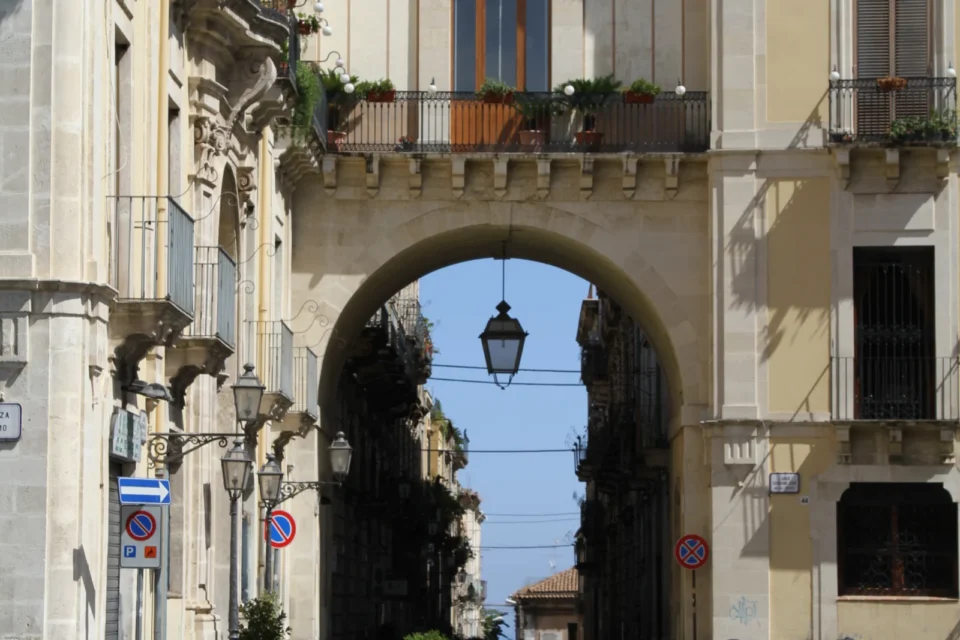
Why visit
Acireale rewards travellers who like their baroque served with normal life. The historic centre is dense with eighteenth-century palazzi whose wrought-iron balconies and carved masks show off the local pairing of dark Etna basalt and honey-coloured Siracusan stone. Etna, forever present to the west, lends the town its lemons and its light, while to the east the sheer lava wall of La Timpa falls toward a blue Ionian Sea and the little port of Santa Maria La Scala. Between the two lies a city of steep lanes, grand religious facades and one of the island’s oldest literary academies. Come in February and the carnival fills the streets with towering papier-mâché floats; come in September and you will share the granita shops mainly with locals. Either way, you eat extraordinarily well at prices gentler than Taormina’s, with Etna’s vineyards a short drive inland.
Character and history
Legend gave the town its founding myth: the shepherd Acis, beloved of the nymph Galatea, whose blood was said to run in the river Acis nearby. Romans knew a settlement here called Acium and came for the thermal springs. The medieval town took shape in the late fourteenth century when Aquilia Nova was founded on higher ground, and Charles V freed it from feudal lordship in the sixteenth. The catastrophic earthquake of 1693 levelled most of the buildings, and the baroque city you see today is the product of that rebuilding, funded in part by a flourishing coral and silk trade. The town’s carnival is documented as far back as 1594, making it one of Sicily’s oldest. In 1861 Acireale earned the nickname “sister of Garibaldi” as the first Sicilian city to rise during the Expedition of the Thousand. The Etna lemon grown on these slopes won protected geographical status in 2020.
What to see
Begin on Piazza del Duomo, where the cathedral keeps a marble sundial by the Danish astronomer Peters, its zodiac signs set into the transept floor. Beside it rises the exuberant Basilica di San Sebastiano, the finest expression of Acese baroque, its limestone facade a lacework of statues and garlands. Its neighbour, the Basilica of the Holy Apostles Peter and Paul, anchors the square’s other flank with an emphatic bell tower. Walk downhill through the public gardens to the edge of the Reserve Naturale La Timpa, where the eighteenth-century Chiazzette path, once the town’s only link to the sea, zigzags down the cliff to Santa Maria La Scala; the walk back up earns you a swim. In the town hall, the Palace di Città di Acireale houses council chambers decorated with local artworks and looks onto the same square. Close the day at the Church of Santa Maria della Neve, set inside a lava cave with an eighteenth-century nativity of life-size wax figures.
How to experience
Time your visit loosely around the rhythms of the town. The carnival season, culminating before Lent, brings allegorical floats and the flower-decked parade of the Festa dei Fiori; details change yearly, so check the official carnival site. On any ordinary day, order a granita with brioche — here served with a squeeze of local lemon and mint in the old-fashioned style — and take the stairs down to the coast. A bicycle or scooter makes the coast road toward Santa Tecla and Stazzo pleasant, passing seafood restaurants on stilts above the water. In January the feast of San Sebastiano fills the streets with devotion and music; in September the Fiera dello Jonio trades on the town’s craft traditions, papier-mâché included. Good hiking shoes will serve you better than beach shoes if you plan the Timpa trails.
Practical planning
Acireale sits on the Catania–Siracusa rail line, with frequent trains from Catania and the airport, though a car is useful for the Timpa, the coastal villages and Etna’s slopes. The centre is hilly and paved in smooth basalt slabs that turn slick when wet; pack grip-soled shoes. Hotels are small, family-run and far cheaper than the coast’s resort towns, but summer weekends still warrant booking. Festival dates, church visiting hours and reserve access all shift seasonally — confirm on the municipality’s site, comune.acireale.ct.it, before you travel.
Nearby places
Catania, Sicily’s boisterous second city, lies twenty minutes south with its fish market and Roman amphitheatre. The upper slopes of Mount Etna make the obvious excursion for wine, lava landscapes and crater walks. North along the coast, Taormina offers its Greek theatre and cosmopolitan promenade.
Worth building a day around.
Basilica dei Santi Pietro e Paolo
Regione Siciliana - Dipartimento Turismo, Sport e Spettacolo (Visit Sicily), in “Acireale - Visit Sicily”, identifies Basilica dei Santi Pietro e Paolo as a…
Basilica di San Sebastiano
Regione Siciliana — Visit Sicily, in “Places and cities - Visit Sicily”, identifies Basilica di San Sebastiano as a visitor-relevant attraction associated with Acireale.…
Palazzo di Città di Acireale
Regione Siciliana — Visit Sicily, in “Places and cities - Visit Sicily”, identifies Palazzo di Città di Acireale as a visitor-relevant attraction associated with…
Riserva Naturale La Timpa
Regione Siciliana — Visit Sicily, in “Places and cities - Visit Sicily”, identifies Riserva Naturale La Timpa as a visitor-relevant attraction associated with Acireale.…
Journeys in Acireale.
Demo — Acireale Private Highlights Tour
Let a local expert design your Acireale day.
Tell us your dates and pace. A travel designer replies within one working day.