Palestrina
On a spur of the Prenestini mountains south-east of Rome, Palestrina stacks ancient temples, a treasure-filled museum and a living hilltown on the same slopes. The modern streets climb directly over the terraces of Roman Praeneste, so every walk through town is also a walk through one of ancient Italy’s grandest sanctuaries.
Why visit
Palestrina compresses an unusual amount of substance into a small hilltown. Its dominating sanctuary of Fortuna Primigenia was described by the regional authority as the greatest late-Republican complex of ancient Italy, and the best of its finds — bronzes, engraved mirrors and the celebrated Nile Mosaic — are displayed in the museum at the top. Add a Roman forum that survives as the main piazza, a cathedral incorporating a temple, and a town that gave Renaissance music one of its greatest composers, and you have a day trip from Rome that feels like several destinations in one. It is compact enough to see unhurried, yet rich enough to reward a second look.
Character and history
Ancient Praeneste dominated the countryside south of Rome for centuries, growing in terraces up the slopes of Monte Ginestro. Its oracle of Fortuna drew pilgrims seeking the goddess’s famous sortes — lots drawn, Cicero tells us, by a boy lowered into the sanctuary’s sacred well. In monumental form at the end of the second century BC the sanctuary became a cascade of ramps, stairways and porticoes rising to a circular temple, among the finest expressions of Roman Hellenistic architecture. Allied with and later absorbed by Rome, the town flourished on eastern trade, and its artistic flowering between the fourth and first centuries BC fills the museum today.
The medieval and modern town grew over the ruins. Bombs in 1944, grimly, uncovered more of the sanctuary, and post-war excavation brought the terraces back to light. The Barberini palace built into the sanctuary’s upper tiers has housed the National Archaeological Museum since 1956. The town’s very name is inseparable from Giovanni Pierluigi da Palestrina, the polyphonist whose music still echoes in the cathedral on Corso Pierluigi.
What to see
Start at the National Archaeological Museum of Praeneste, laid out through the Barberini palace; its centrepiece is the Nile Mosaic, a late second-century BC panorama of Egypt by Alexandrian mosaicists, beside fine bronzes, cistae and engraved mirrors. Steps and ramps outside trace the terraces of the Sanctuary of Fortuna Primigenia, whose ramps and viewing terraces now frame the valley. Below, the Forum of Praeneste survives beneath Piazza Regina Margherita, with remnants of paving, the public treasury and grand second-century BC buildings nearby. The Cathedral Basilica of Saint Agapitus Martyr crowns Corso Pierluigi, incorporating an ancient temple into its structure.
How to experience
Work uphill: begin at the forum and piazza, wander the medieval lanes, then climb through the sanctuary terraces to the museum at the top, where the Nile Mosaic alone justifies the ascent. Take the climb slowly — the terraces were designed to be experienced as a sequence, and each landing rewrites your view of the valley and the rooftops below. Time a visit for late August if you can — the Palio di Sant’Agapito brings three days of festivities, including the Giostra della Scifa in which a galloping knight threads a lance through a metal ring. Local tables serve Sagna pasta and lily-shaped Giglietti biscuits, and workshops still work copper and wrought iron. Check the museum’s official site, gabiipraeneste.cultura.gov.it, for current opening arrangements.
Practical planning
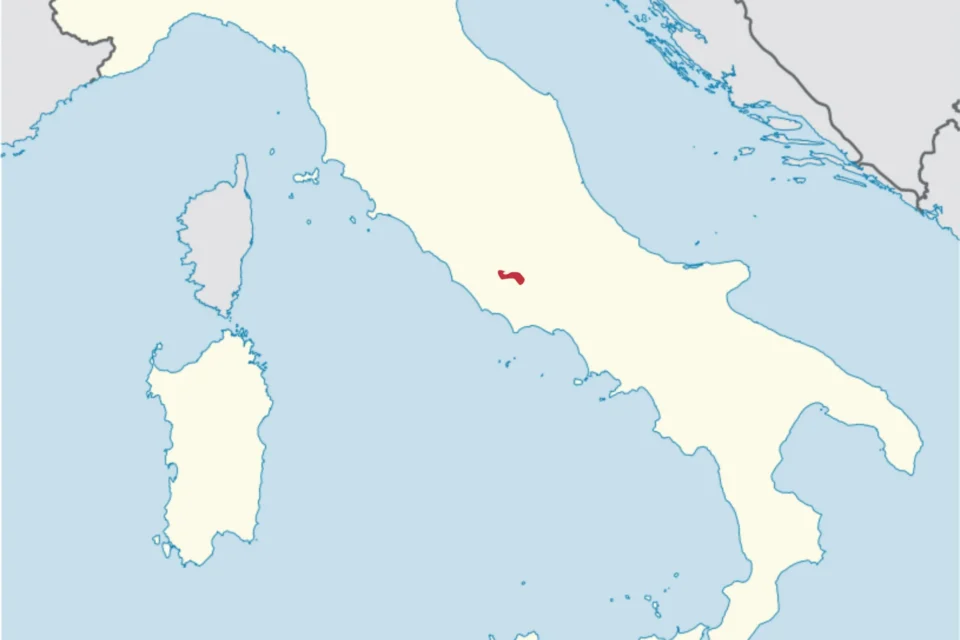
Palestrina lies roughly forty kilometres east of Rome, reached by car via the A19 or by regional transport towards the Prenestini towns; a car makes pairing it with nearby sites easier. Comfortable shoes are essential, as the town’s lanes and sanctuary ramps climb steadily. Half a day suffices for the essentials; add time for lunch with a view from the upper terraces. Many travellers pair Palestrina with a stop in one of the Castelli villages on the way back to Rome, turning the excursion into a full day across the Alban hills. Hours for the museum and archaeological areas vary seasonally and around public holidays, so confirm on the official park site before setting out.
Nearby places
The Castelli Romani ring the hills to the west: Frascati, Grottaferrata, Marino and Nemi all make easy companions, as do Castel Gandolfo and Albano Laziale above Lake Albano. To the east, Subiaco leads into the Aniene valley and its Benedictine monasteries, while Tivoli pairs perfectly on a longer itinerary.
Worth building a day around.
Basilica Cattedrale di Sant’Agapito Martire
The municipality documents public worship/music events at the cathedral and gives its address; ordinary worship is free while event access may be reserved.
Foro di Praeneste
The Ministry site gives the Foro di Praeneste as a separate public site and publishes its Piazza Regina Margherita location.
Museo archeologico nazionale Prenestino
The Ministry site identifies the public museum in Palazzo Colonna-Barberini, gives Piazza della Cortina and current cultural programming.
Santuario della Fortuna Primigenia
The Ministry site identifies the sanctuary as a public component of the Praeneste complex at Piazza della Cortina and includes it in the combined…
Journeys in Palestrina.
Demo — Palestrina Private Highlights Tour
Let a local expert design your Palestrina day.
Tell us your dates and pace. A travel designer replies within one working day.