Panicale
Panicale crowns a hill above Lake Trasimeno with three concentric rings of medieval brick wall and what locals fairly call the lake’s finest terrace. A Perugino fresco of 1505, a miniature theatre, a museum of handmade tulle and a late-Renaissance sanctuary full of frescoes give this small Umbrian borgo an artistic weight far beyond its size.
Why visit
Panicale compresses the pleasures of Umbria into an afternoon’s stroll that easily becomes a week’s stay. The elliptical borgo climbs Monte Petrarvella, its three squares stacked at different levels — the economic Piazza Umberto I, the religious ground of San Michele Arcangelo, the political Piazza Masolino — and from its belvederes the lake spreads out below in silvery bands of water and reed bed. The views over Trasimeno and the Nestore valley are the town’s constant backdrop, framed every few steps by an archway or a lane.
Yet Panicale is not only a viewpoint. It holds one of Perugino’s most gracefully preserved frescoes; one of Italy’s smallest theatres, lovingly kept in use; a museum devoted to the tulle embroidery that made the town famous among connoisseurs; and a landscape dotted with castles, sanctuaries and land-art installations. It rewards the traveller who wants Renaissance art and lake life without crowds.
Character and history
The name may derive from Pan, or more prosaically from panìco, a millet once grown so abundantly here that the area served as Perugia’s granary — the grain plant still appears on the town’s coat of arms. Founded by the Etruscan city-state of Chiusi between the seventh and sixth centuries BC, Panicale sheltered Roman legionaries fleeing Hannibal after the battle of Lake Trasimeno in 217 BC and appears again in the records of the Perusine War of 41 BC.
The medieval commune declared itself free in 1037 and passed under Perugia in 1201, which rebuilt its walls in 1246 and strengthened them in 1312. Popes and emperors came this way — Innocent III, Henry VII, Alexander VI, Julius II, and Paul III, who built the town’s rocca — before the settlement passed definitively to the Papal States in 1540. It produced a condottiero, Boldrino da Panicale, a poet, Cesare Caporali, and claims the painter Masolino da Panicale among its sons. That layered history survives in the walls and the two gates, Porta Perugina and Porta Fiorentina with the traces of its drawbridge.
What to see
The artistic heart is the Church of San Sebastiano, a small brick building of the late fifteenth century just outside the walls, where Perugino signed and dated his Martyrdom of Saint Sebastian in 1505 across the entire back wall: the saint at a porphyry column, archers with Raphaelesque faces, and through the painted loggia a real view of hills and lake. A fresco of the Madonna with musical angels here is attributed by some to the young Raphael. On the main square, the Collegiate Church of San Michele Arcangelo, founded in the eleventh century but baroque in its present form, keeps an Annunciation attributed to Masolino and works by Giovan Battista Caporali.
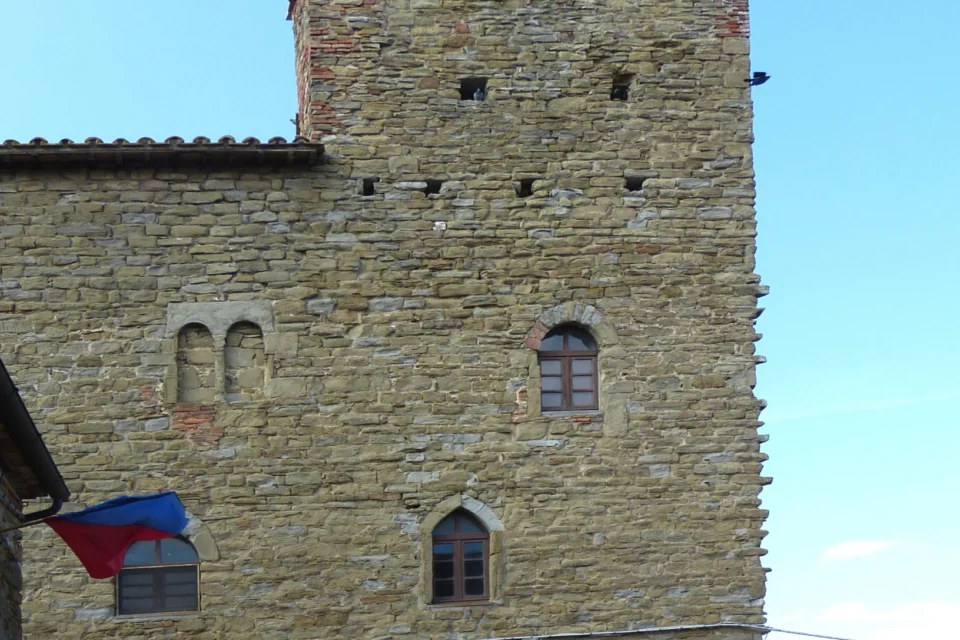
Next door, the eighteenth-century Teatro Cesare Caporali, remodelled mid-century into the classic Italian form, ranks among the smallest theatres in the country, while the Tulle Museum, in the former church of Sant’Agostino, honours Anita Belleschi Grifoni, who revived the town’s celebrated tulle embroidery through the Ars Panicalensis workshop. The Church of the Madonna della Sbarra and Museum of Sacred Vestments and the fourteenth-century Palazzo del Podestà on Piazza Masolino complete the historic centre, and the Panicale Belvedere delivers the lake panorama that justifies every postcard. Below the hill at Tavernelle, the Santuario di Mongiovino, a Marian sanctuary of the early sixteenth century, preserves one of Umbria’s most important late-Cinquecento fresco cycles, with hands from Tuscany, the Marche and Holland.
How to experience
Structure a visit around light and food. Arrive in the morning for the churches while the light falls softly on the frescoes, lunch on lake fish or classic Umbrian dishes in a piazza café, then climb to the belvedere in the golden hour when Trasimeno turns copper. Check whether the theatre is open for a visit or a small performance — it is a civic jewel still loved by the town. Walkers can link Panicale towards the lake shore and through the surrounding olive country, and the area’s land-art circuit adds contemporary sculpture to the views. In September the Fili in Trama textile event celebrates the town’s embroidery tradition, and the Pan Opera Festival has brought music to the squares.
Practical planning
Panicale lies roughly 25 kilometres south-west of Perugia, reached by car via Tavernelle, the practical approach; train travellers usually arrive via Chiusi or Perugia and continue by bus or taxi. Park below the walls and walk up — the centre is compact but stepped. Accommodation ranges from agriturismi in the surrounding hills to small hotels towards the lake. Opening hours of the theatre, tulle museum and sanctuary are seasonal and sometimes limited to guided slots, so verify locally before planning around them; summer is liveliest, spring and autumn quieter and cooler.
Nearby places
The lake towns cluster invitingly close. Castiglione del Lago, with its ducal palace on the western shore, and Passignano sul Trasimeno, the main ferry point on the northern shore, are both short drives around the water, and the Lake Trasimeno area page gathers islands, beaches and boat trips. Perugia, the provincial capital, lies within half an hour for galleries and city dining.
Worth building a day around.
Belvedere di Panicale
Described on official Terre del Perugino itinerary page.
Chiesa della Madonna della Sbarra e Museo dei Paramenti Sacri
Combined guided-tour tariff published on official Terre del Perugino San Sebastiano page.
Chiesa di San Sebastiano
Published hours and tariff on official Terre del Perugino page.
Collegiata di San Michele Arcangelo
Identity and artistic content confirmed by Terre del Perugino; current opening regime not published on consulted sources.
Museo del Tulle
Combined guided-tour tariff published on official Terre del Perugino San Sebastiano page.
Palazzo del Podestà
Identity confirmed by Terre del Perugino itinerary page; exterior viewable at all times.
Santuario di Santa Maria di Mongiovino
Identity and artistic value confirmed by Terre del Perugino; current visiting regime not published on consulted sources.
Teatro Cesare Caporali
Official Terre del Perugino pages confirm existence and guided visits.
Journeys in Panicale.
Demo — Panicale Private Highlights Tour
Let a local expert design your Panicale day.
Tell us your dates and pace. A travel designer replies within one working day.