Pacentro
Stacked on the slopes of Monte Morrone above the Peligna valley, Pacentro is one of Abruzzo’s best-preserved medieval borghi, crowned by a great Caldora fortress with twin towers that watch over a web of lanes, fountains and noble houses inside the Majella National Park.
Why visit
Pacentro delivers the classic Abruzzese hill-town experience with unusual integrity. The village clings to the mountainside at over 700 metres, its houses rising in ordered ranks toward the castle whose two square towers have become the emblem of the entire Sagittario valley. Officially counted among Italy’s most beautiful villages, it has kept a living centre — grandmothers at their doors, festival preparations, water still running from medieval fountains — rather than a stage set. The Caldora Castle ranks among the best-preserved fortified structures of Abruzzo, and the borgo below is an unbroken fabric of fourteenth- and fifteenth-century houses, painted facades and small churches. Set inside the Majella National Park, the town doubles as a trailhead: hermit paths, beech woods and the road up the Morrone all begin at the edges of the old quarter. For travellers touring between Sulmona and the high plateau, Pacentro is the natural lunch-and-wander stop that ends up taking the whole afternoon.
Character and history
A castellum of Pacentro already appears in the eleventh-century Chronicon Casauriense, and the village grew under the Abbazia di San Clemente a Casauria before passing to the great baronial families of the kingdom. Its fortune was made in the late fourteenth and fifteenth centuries, when the castle took its present form under the Caldora and then the Cantelmo lords: a four-sided fortress of three inner square towers and, after 1418, round embattled corner towers within a double curtain wall. Later centuries brought the Orsini, Colonna and Barberini, and a slow decline eased only by emigration and, in our own day, careful restoration — the comune acquired the castle in 1957 and has restored it in successive campaigns. Local life keeps its rituals: the village’s traditional dance, performed in historical dress at summer festivals, and the craft and food fairs of the park calendar. The stone of the lanes, the patterned shingles of old roofs and the repeated white oxen painted on house walls give Pacentro a look no photograph quite prepares you for.
What to see
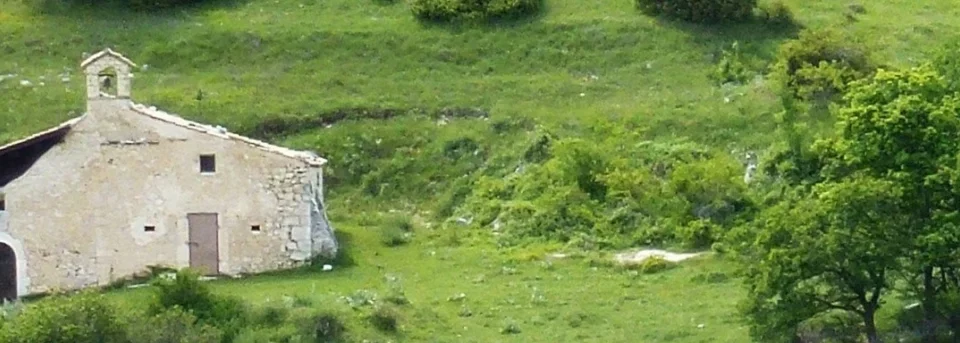
Start at the top: the Caldora Castle is partly visitable, its south tower climbed by an internal staircase, and from the walls the valley and the Morrone ridge unroll. Below, the Historic Village of Pacentro is itself the monument — arcaded streets, the painted crests of old families, and a sequence of churches that reward a slow circuit. The parish Church of Santa Maria della Misericordia anchors the sacred heart of the borgo; outside the walls stand the sixteenth-century rural Church of the Madonna degli Angeli on the Via del Colle, the Church of the Madonna di Loreto tied to popular devotion, and the country Church of San Marco in its contrada. In the centre, the civic collection housed at the Museum of Palazzo La Rocca records local life and craft, and the Casa di Marlurita (historic farmhouse museum) preserves a peasant farmhouse interior exactly as its last occupant left it. Look for La Preta Tonna (Stone of Scandal) in the lanes — a threshold stone wrapped in village legend and still pointed out by locals.
How to experience
Enter the borgo on foot from the valley road and climb slowly; the alleys are stepped and shaded, and the payoff at the castle gates is earned. Time a visit for one of the summer historical festivals, when the town dances its saltarello in costume and the castle hosts evening events — dates are posted on the municipal site, comune.pacentro.aq.it, and the park portal. Pair the village with the outdoors: the path from the top of the borgo heads toward the Morrone hermitage country, and short park trails thread the slopes above town; ask at the Majella information points for current routes. Eat where the locals eat — the valley’s arrosticini and handmade pasta appear on small trattorie menus, and the park’s slow-food lard and legumes show up at fairs. A full visit needs only half a day, but photographing the castle towers at golden hour from the road below is worth planning for.
Practical planning
Pacentro lies about 10 minutes’ drive from Sulmona, the practical rail gateway with connections to Rome and Pescara; by car, the A25 (Pratola Peligna exit) brings you within a quarter of an hour. Parking sits below the historic centre — the lanes are pedestrian — and comfortable shoes are essential for the stepped alleys. The castle keeps daily visiting hours that stretch seasonally (shorter in winter, longer in summer), but confirm on the comune site before travelling. Spring and autumn give the clearest views across the valley; summer festivals crowd the village pleasantly. There are small B&Bs and rooms in the borgo; Sulmona offers fuller hotels. Bring a windbreaker for the castle walls even in August.
Nearby places
Sulmona, the confetti capital in its mountain ring, is the nearest city and the natural pairing; downstream on the plateau, Pratola Peligna and the great abbey country begin. Over the ridge to the south lie the high towns of Pescocostanzo and Scanno, and eastward the road runs to Pescasseroli and the old national park; L’Aquila, the regional capital, waits beyond the Morrone to the northwest.
Worth building a day around.
Borgo storico di Pacentro
Ente Parco Nazionale della Majella descrive il borgo e le contrade medievali come percorso di visita; borgo inserito tra i Borghi più belli d'Italia.…
Casa di Marlurita
Catalogo luoghi comunale; Ente Parco Maiella include la Casa-Museo di Marlurite nel percorso guidato 'Pacentro tra Storia e Sapori'. Casa contadina d'inizio Novecento allestita…
Castello Caldora
Scheda ufficiale del Comune (orari e visita); Ente Parco Nazionale della Majella conferma ingresso a pagamento 2,50 €. Aperto al pubblico con orario stagionale…
Chiesa della Madonna degli Angeli
Scheda ufficiale del Comune di Pacentro (luogo_13). Accesso gratuito, priva di barriere architettoniche, 'sempre aperta in orario diurno'; funzioni religiose in orari parrocchiali.
Chiesa della Madonna di Loreto
Scheda ufficiale del Comune di Pacentro (luogo_14). Accesso gratuito; ingresso e parcheggio accessibili in sedia a rotelle; 'sempre aperta in orario diurno'.
Chiesa di San Marco
Catalogo luoghi comunale; la contrada di San Marco è tappa del percorso dell'Ente Parco. Catalogata tra i luoghi di culto del Comune; orari non…
Chiesa di Santa Maria della Misericordia
Catalogo luoghi comunale (Chiesa della Misericordia, ITA-ENG); Ente Parco Maiella la cita come chiesa parrocchiale del percorso di visita. Chiesa parrocchiale del borgo, inclusa…
La Preta Tonna (pietra dello scandalo)
Catalogo luoghi comunale ('La preta tonna – la pietra dello scandalo'); Ente Parco la cita tra le tappe del percorso. Elemento del centro storico…
Museo di Palazzo La Rocca
Catalogo luoghi comunale ('Ingresso museo – Palazzo La Rocca, sede museale'). Palazzo La Rocca indicato dal Comune come sede museale; orari e biglietteria non…
Journeys in Pacentro.
Demo — Pacentro Private Highlights Tour
Let a local expert design your Pacentro day.
Tell us your dates and pace. A travel designer replies within one working day.