Ostuni
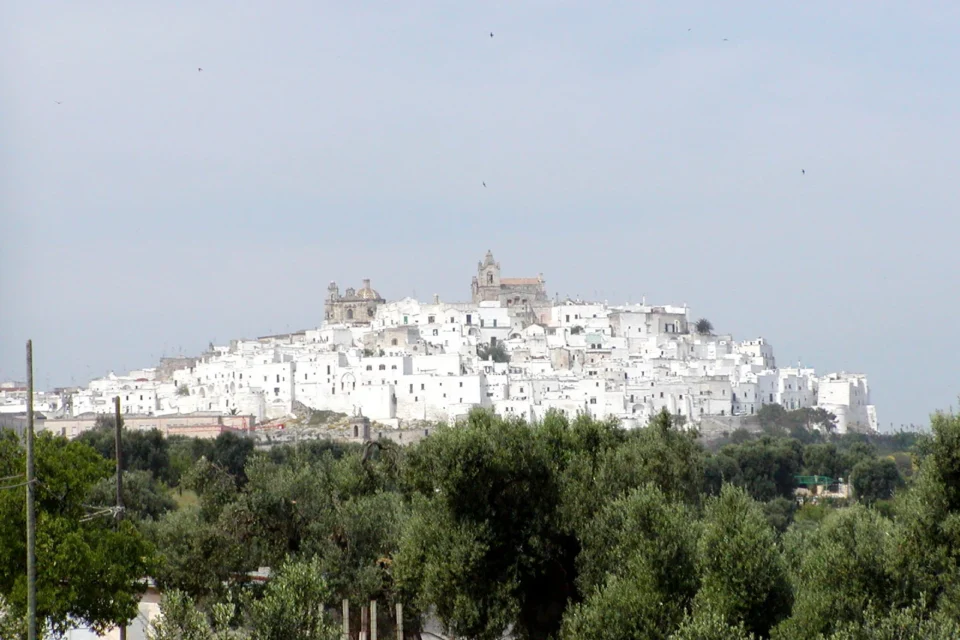
Ostuni rises from a sea of ancient olive groves to a luminous hilltop maze of lime-whitened houses, the celebrated White City of southern Puglia. Beneath the postcard surface lies one of Europe’s oldest stories: a Paleolithic burial found nearby reshaped what we know about the region’s first inhabitants.
Why visit
Few towns in Italy announce themselves so dramatically. Coming from the coast, you see Ostuni long before you reach it — a crowning cluster of white walls on its hill, glowing against the green-grey expanse of centuries-old olive trees. The old town rewards unhurried wandering: stepped alleys, arched passages, cascades of geraniums, and sudden views over the plains to the Adriatic. It pairs beautifully with the gastronomy of the surrounding countryside, and its archaeological heritage gives the visit real depth beyond the views.
Character and history
The hill has been settled since remotest antiquity. According to the municipal administration, the centre’s origins reach back to the Messapian era, with later growth under the Romans and in the medieval period. After Hannibal’s destruction during the Punic Wars the site was rebuilt, and from 996 it belonged to the Norman County of Lecce; it was the Normans who organised the town around the hilltop, with walls and gates whose lines still shape the old centre. Between 1300 and 1463 Ostuni formed part of the Principality of Taranto, and in 1507 it passed to Isabella, Duchess of Bari, later via her daughter Bona Sforza towards the Polish crown — a courtly chapter that left its mark on the town’s monuments. In 1539 coastal watchtowers were raised against raids from the sea.
The whiteness itself is practical as much as picturesque: houses were traditionally coated in lime wash, a material valued for its reflective and hygienic qualities, and residents still renew it, keeping the town brilliant.
What to see
Begin in the Historic Centre of Ostuni (the White City), a labyrinth of alleys that opens, at the summit, onto the Ostuni Cathedral (Cathedral of Santa Maria Assunta). The municipality describes the fifteenth-century church as a Gothic masterpiece, with a richly traceried rose window on the facade and a Baroque interior inside. Below, Piazza della Libertà gathers the town’s civic life around the baroque Column of Sant’Oronzo, flanked by the Church of San Francesco d’Assisi, the Cloister of San Francesco and the Palazzo San Francesco (Town Hall).
For history in the deeper sense, the Civic Museum of Ostuni, housed in the Church of San Vito Martire, traces the territory from the Messapians to the Middle Ages and displays its most precious find: the “Donna di Ostuni”, the skeleton of a pregnant woman from the Paleolithic era. The discovery site itself can be visited at the Santa Maria d’Agnano Archaeological Park, where a prehistoric cave served as a place of burial and cult since the Paleolithic, set among olive groves with views to the sea. Sacred art fills the Diocesan Museum of Ostuni beside the cathedral, while the Villa Comunale Sandro Pertini (public gardens) offer the classic panorama from the old ramparts, and the monumental Antelmi Staircase makes a photogenic descent through the whitewashed lanes.
How to experience
Ostuni is best explored on foot, early or late in the day when the light turns the walls gold and the day-trippers thin out. Eat in the historic centre: orecchiette with turnip tops, bread from the wood-fired ovens, and olive oil pressed from trees that have stood here for centuries — the surrounding plain is one of Puglia’s great olive landscapes. The coast is a short drive away for afternoons on the Adriatic, and the White City makes an excellent base for day trips through the Itria Valley. Check the comune’s tourism pages (comune.ostuni.br.it) for current opening arrangements of the museums, cathedral and archaeological park before you go.
Practical planning
Ostuni has its own railway station on the Adriatic line, about four kilometres downhill from the old town, with local connections towards Bari and Lecce; most visitors arrive by car and park at the edges of the pedestrian zone. Comfortable shoes matter — the centre is steep and stepped, and parts are not easily accessible for people with reduced mobility, as the municipality notes. Spring and autumn bring mild weather and the olive groves at their most atmospheric; summer is lively but crowded. Museums and monuments keep hours that vary by season, so confirm details on the official sites.
Nearby places
The hill towns of the Itria Valley are close at hand: Cisternino, known for its whitewashed old quarter and its famous butchers’ counters, and Fasano, the gateway between the olive plain and the coast, are both within easy reach for a day’s exploring.
Worth building a day around.
Biblioteca Comunale Francesco Trinchera Senior
Municipal page: key cultural institution hosting public readings and events.
Cattedrale di Santa Maria Assunta
Municipal cathedral page: 15th-century cathedral at the highest point of the old town, Gothic facade with decorated rose window, Baroque interior with artworks, accessible…
Centro Storico di Ostuni (La Città Bianca)
Municipal page describes the lime-whitened old town on a panoramic hill, freely walkable. Hilly maze of lanes with steps; partially difficult for reduced mobility.
Chiesa di San Francesco d'Assisi
Municipal page: 15th-century church, one of the city's main places of worship.
Chiesa di San Vito Martire
Municipal page: built in 1750, one of the finest Baroque examples in Ostuni; the building also houses the Museo Civico.
Chiostro di San Francesco
Municipal page: next to the Town Hall in the historic centre, one of the most evocative historic spots of the Città Bianca; used as…
Colonna di Sant'Oronzo
Municipal page: obelisk in Piazza della Libertà made in 1771 by sculptor Giuseppe Greco in gratitude to the patron saint for saving the city…
Museo Civico di Ostuni
Municipal page: archaeological and historical collection from the Messapians to the Middle Ages, including the Paleolithic 'Donna di Ostuni'; housed in the Church of…
Museo delle Civiltà Preclassiche della Murgia Meridionale
Municipal page: the institution manages the archaeological museum and the Santa Maria d'Agnano park.
Museo Diocesano di Ostuni
Municipal page: next to the Cathedral in the former Bishop's Palace, holding sacred art, liturgical furnishings and historic documents.
Palazzo San Francesco (Municipio)
Municipal page: major historic building on Piazza della Libertà housing the Town Hall, adjoining the San Francesco cloister.
Parco Archeologico di Santa Maria d'Agnano
Municipal page: archaeological park famous for the discovery of the 'Donna di Ostuni'; amphitheatre on site used for public events.
Piazza della Libertà
Municipal page: pulsating heart of Ostuni's social and cultural life, framed by historic buildings. Open square at the foot of the old town.
Santuario di San Biagio
Municipal page on the Festa di San Biagio: pilgrims walk to the sanctuary in the Ostuni woods for the traditional throat blessing. Reachable on…
Scalinata Antelmi
Municipal page: scenic staircase near Piazza della Libertà dedicated to local priest Don Elio Antelmi. Steps only.
Villa Comunale Sandro Pertini
Municipal page: one of the city's main green spaces, along the panoramic avenue on the old walls.
Journeys in Ostuni.
Demo — Ostuni Private Highlights Tour
Let a local expert design your Ostuni day.
Tell us your dates and pace. A travel designer replies within one working day.