Nemi
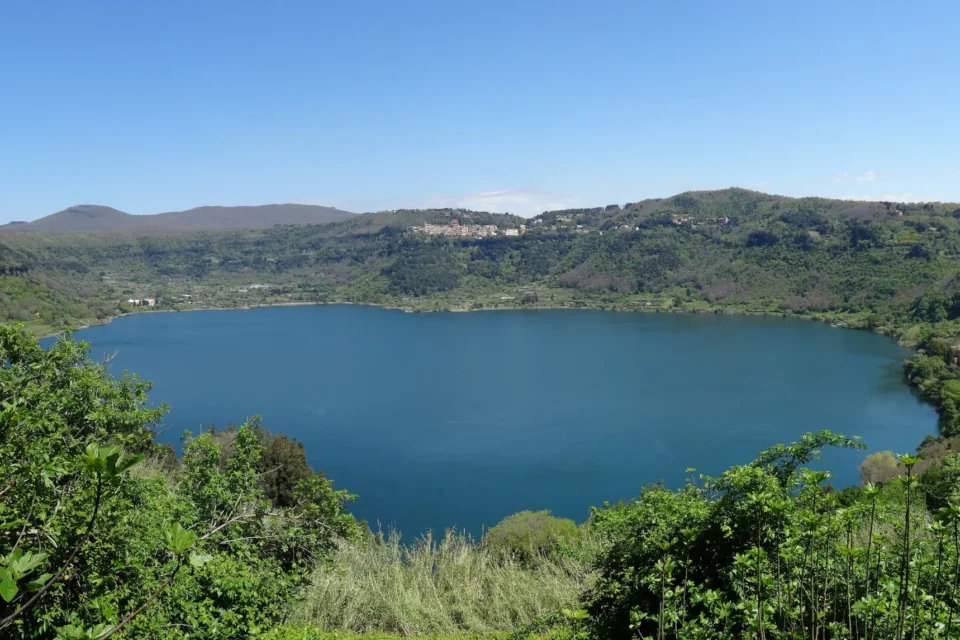
Nemi perches on the rim of a volcanic crater above one of Italy’s most storied small lakes, a village of strawberries and flowers where Caligula’s great ships once lay preserved on the lakebed. Myth, archaeology and views combine within a short walk, making it one of the most evocative stops in the Castelli Romani.
Why visit
Nemi compresses an extraordinary amount of story into a tiny space. The lake below the village is the mirror of Diana’s sacred valley, a place Roman writers considered so holy that its priests were once runaway slaves who won their office in combat — the rex Nemorensis that inspired Frazer’s The Golden Bough. In the lakebed lay two colossal ceremonial ships built for the emperor Caligula, recovered in one of archaeology’s most audacious operations and now displayed, in their surviving remains, in a museum on the shore. The village itself is a pleasing cluster of lanes and flower-bedecked balconies, officially recognised among Italy’s Orange Flag borgos, with terraced viewpoints over the water and a spring strawberry tradition celebrated every June. For travellers based in Rome, Nemi pairs naturally with Castel Gandolfo, Frascati and the Castelli circuit, yet its atmosphere — misty mornings over the crater, goddess myths, lake fish and wild strawberries — is entirely its own.
Character and history
The valley and its village carry some three thousand years of continuous worship and cultivation. Near the shore stood the sanctuary of Diana Nemorensis, “Diana of the Wood”, one of Latium’s great religious centres, studied by antiquarians since the sixteenth century and still yielding finds. Myth placed the goddess and her lover Virbio in this valley, and the romantic associations cling to the viewpoints above the water today. The village grew on the crater rim above, passing through baronial hands — the Ruspoli palace remains its most substantial historic residence — while the woods of holm oak and chestnut around the lake sustained farmers and foresters. The modern chapter is the most dramatic: between 1929 and 1932, engineers lowered the lake by more than ten metres through an emissary channel to expose Caligula’s two giant ships, which had sunk after his death amid the condemnation of his memory. A purpose-built museum opened to display them, and on a night in May 1944 wartime fire destroyed the hulls — a loss mourned by archaeologists worldwide, whose surviving timbers and fittings still testify to Roman shipbuilding at its most ambitious.
What to see
The Museum of the Roman Ships (Nemi) on the lake’s northern shore is the anchor visit: one wing preserves what remains of the two imperial vessels, the other displays material from the Castelli and the lake’s ancient sanctuary, and the building itself is a rationalist landmark of the 1930s. Below the village, the Sanctuary of Diana Nemorensis marks the sacred valley where the lake’s cult centred. The Lake Nemi itself invites a circuit walk — wooded, circular and quiet, with fishing boats and lakeside cafés.
Up in the borgo, Palazzo Ruspoli (Nemi) embodies the town’s noble past, while the small churches of the Church of the Crucifix (Nemi) and the Church of Santa Maria del Pozzo (Pullarella) preserve its devotional life. Finish at the two viewpoints: the Terrace of Lovers and the Myths of the Lake Valley, opened in 2015 and themed on the valley’s love myths, and the Ceyrat Belvedere, whose terrace hangs over the crater with the whole lake below.
How to experience
Give Nemi a half-day at minimum, ideally lingering into the evening. Begin at the ships museum when it opens, then walk down to the lake for the circular path, or swim at the small beach in summer. Ascend to the village for lunch — lake fish, wild strawberry desserts and the local breads — followed by the belvederes, which are at their best in the late-afternoon light. Time your visit for early June if you can, when the strawberry festival fills the lanes with stalls, music and fragole al limoncello. Those interested in the deeper story can combine the sanctuary site with the museum’s collections, and hikers can pick up paths across the crater toward Genzano or the woodlands of the regional park. The museum keeps a weekly closing day and, as works are periodically scheduled in the building, confirm its current status through the official channels before travelling; the village itself, the viewpoints and the lake path need no booking and never close.
Practical planning
Nemi lies about thirty kilometres southeast of Rome in the Castelli Romani regional park area. By public transport, the practical route is the train to Genzano or the connecting buses that wind up from the lowland towns; a car makes the crater roads easy and links Nemi with Frascati, Grottaferrata and Castel Gandolfo in minutes. The borgo is steep and cobbled, so wear comfortable shoes, and park outside the historic core. Spring and autumn are glorious, with wildflowers on the crater and clear views; summer weekends draw Romans to the cool air, and the June strawberry festival is the busiest week of the year. Museum tickets are modest and often free on state-museum free days; opening details change with restoration schedules, so check the municipal tourism portal (visit.comunedinemi.rm.it) before setting out.
Nearby places
The Castelli surround the crater. Marino lies on the far side of the lake, Ariccia is famed for its porchetta, Albano Laziale rises above Lake Albano, and Castel Gandolfo holds the papal palace overlooking that second lake. To the north, Frascati and Grottaferrata make easy pairings, while Tivoli and Ostia Antica are full-day excursions in either direction.
Worth building a day around.
Belvedere Ceyrat
Belvedere elencato tra i punti panoramici del borgo dal portale turistico ufficiale del Comune (VisitNemi). unknown
Chiesa del Crocifisso
Chiesa storica del borgo elencata dal portale turistico ufficiale del Comune (VisitNemi); aperta al culto, visita interna gratuita. unknown
Chiesa di Santa Maria del Pozzo
Chiesa storica elencata dal portale turistico ufficiale del Comune (VisitNemi) anche come 'Pullarella'; aperta al culto. unknown
Lago di Nemi
Portale ufficiale VisitNemi: lago nel cratere di un antico vulcano circondato da boschi, nel Parco Regionale dei Castelli Romani; area fruita liberamente con punti…
Museo delle Navi Romane
Scheda con contatti ufficiali MiC (drm-laz.naviromane@cultura.gov.it, tel. 06 9398040): edificio di Vittorio Ballio Morpurgo (anni 1930) per le navi di Caligola recuperate dal lago…
Palazzo Ruspoli
Elencato tra i luoghi storici del borgo dal portale turistico ufficiale del Comune (VisitNemi); esperienza pubblica interna non documentata dalla fonte (unknown), visita esterna…
Santuario di Diana Nemorense
Portale turistico ufficiale del Comune (VisitNemi): il santuario di Diana Nemorense nella valle lacustre, studiato dagli eruditi dal XVI secolo; molti reperti sono esposti…
Terrazza degli Innamorati e i Miti della Valle del Lago
Punto panoramico ufficiale inaugurato dal Comune il 14 febbraio 2015 e dedicato ai miti della valle del lago (Diana e Virbio, Numa Pompilio); elencato…
Journeys in Nemi.
Demo — Nemi Private Highlights Tour
Let a local expert design your Nemi day.
Tell us your dates and pace. A travel designer replies within one working day.