Narni
Strung along a gorge of the Nera on the old Flaminian Way, Narni — the Roman Narnia — keeps a medieval core of arches and towers, an Albornoz fortress above the rooftops, and secrets below: an underground church, an Inquisition tribunal, and the mighty piers of Augustus’s bridge in the valley. Its spring joust, the Corsa all’Anello, is among Italy’s finest.
Why visit
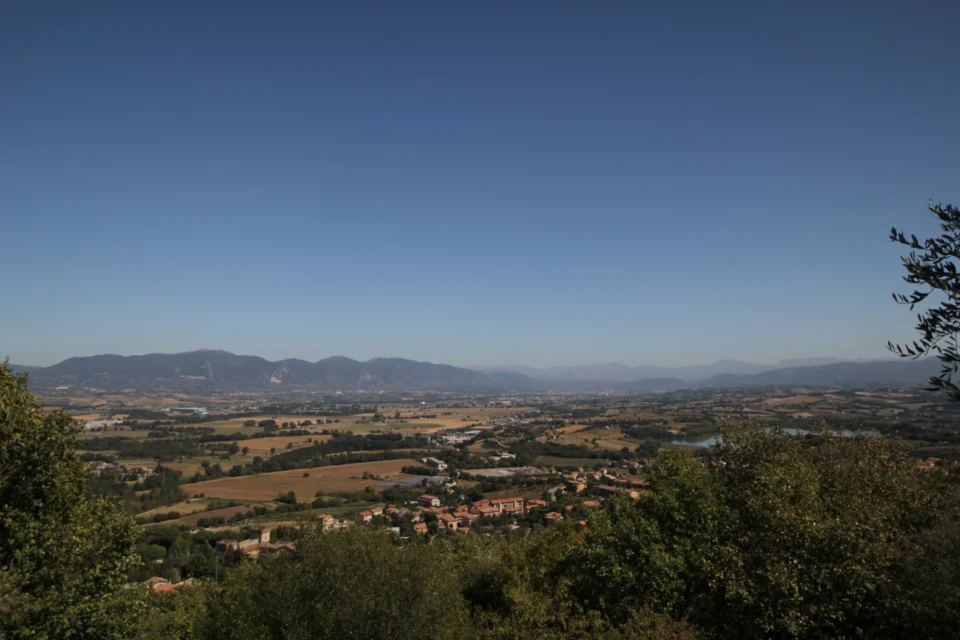
Narni compresses three epochs into one steep, satisfying town. The Romans called it Narnia and fortified the gorge of the Nera on the Flaminian Way; the Middle Ages climbed the hilltop with courts, churches, and palaces; and the Renaissance left a cathedral facade and patrician halls. Above it all stands the Rocca Albornoz, commissioned in 1367 by Cardinal Egidio Albornoz to anchor papal power, its keep now giving the widest views over town and countryside. Below the medieval quarter, guided visits descend into Narni Sotterranea, an underground route through a painted hypogeal church and the cellars of the Inquisition’s tribunal — a discovery of 1979 that reads like a mystery novel. In the valley, the colossal cut piers of the Ponte di Augusto recall a bridge once among the largest of Roman engineering. Add the multimedieval museum devoted to the Corsa all’Anello — a joust held each late April to early May, ranked among the most important in Italy — plus frescoed oratories, a Romanesque church on sloping ground, and riverside Stifone, and Narni becomes the essential southern Umbrian stop between Terni and Amelia.
Character and history
Narni’s biography begins, in written record, as Nequinum, an Umbrian-Sabine stronghold before Roman colonisation renamed it Narnia in the fourth century BC. The gorge position made it a fortress town of the Flaminian Way, and Augustus crowned that role with the great bridge across the Nera at the valley bottom, whose surviving pier still astonishes for scale. The medieval commune rose under papal sovereignty, building the Piazza dei Priori ensemble and the cathedral of Saints Juvenal and Cassius, and in 1367 Cardinal Albornoz began the fortress that asserted the Church’s dominion until works finished in 1378 — a stronghold later sacked by the Landsknechts in 1527 and, over the centuries, host to emperors and popes before serving as a prison into modern times. Modern Narni gained a second identity through its underground: in 1979 a local youth group uncovered the buried church of San Domenico, and archival trailblazing in the Vatican and Dublin archives revealed the Inquisition tribunal that had tried and erased records of its chaplain — a story that has made Narni Sotterranea internationally celebrated. The town’s living tradition, the Corsa all’Anello, keeps the medieval pageantry alive each spring in its ring-shaped piazza games.
What to see
Start at the top: the Albornoz Fortress crowns the medieval quarter at 332 metres, its main keep and battlement walkways open to visitors, with a medieval garden of medicinal beds tied to the zodiac and contemporary exhibitions in the halls of honour. Descend to the cathedral on Piazza Garibaldi — the Cathedral of Saints Juvenal and Cassius, with its Renaissance portico, crypt, and the chapel of the Beata Lucia — and to the civic heart at Piazza dei Priori, where the Priori Palace, Narni City Hall, and the Multimedieval Museum of the Ring Race explain the town’s great joust. Noble facades line the streets: Palazzo Scotti, the museum-and-library Palazzo Eroli Museum and Library with its archaeological section and picture gallery, and the eighteenth-century Giuseppe Manini Theatre.
The Romanesque Church of Santa Maria Impensole anchors the lower lanes, near the Blessed Lucia Complex. Below ground, Underground Narni reveals the hypogeal church, Inquisition cells, and a Roman cistern on a guided circuit. Outside the walls, the Augustus Bridge at Narni Scalo shows the surviving Roman pier; the Cardona Bridge spans the Nera on medieval masonry; the Abbey of San Cassiano sits quietly on the road to Terni; the Sanctuary of Madonna del Ponte and the Sacred Grotto of Saint Francis mark Franciscan devotion; and the riverside hamlet of Stifone Village and Riverside Site closes the loop by the water.
How to experience
Narni works best as a story told vertically and then underground. Book a timed visit of Narni Sotterranea ahead — capacity is limited and reservations are taken by phone — then climb through the medieval quarter with the fortress as your afternoon finale, when the keep’s panorama is at its best. Give the Multimedieval Museum an hour before the Corsa all’Anello season, and if your visit falls between late April and early May, watch the joust itself, when the town’s quarters contest the ring race in full medieval dress. In the valley, pair the Augustus Bridge with the short drive to Stifone along the Nera, and fit the Sacred Grotto of Saint Francis for its atmosphere of early Franciscan prayer. The NarniaPass combines the top attractions economically; trails of the Cammino dei Protomartiri Francescani and CAI paths connect the outlying sites for walkers.
Practical planning
Narni lies in the province of Terni on the Via Flaminia, with the A1 motorway exits at Orte or Magliano Sabina for drivers and a railway station at Narni-Amelia linked by bus to the hill town; the historic centre sits well above the station, so plan the transfer. The centre is a ZTL: leave the car at the signposted Via Roma parking area and walk about ten minutes uphill. Cobbles and steps dominate, so sturdy shoes and light bags matter. Opening hours for the fortress, underground route, and museums vary by season and day of the week — several sites close on weekdays out of season — so confirm times before travelling rather than relying on fixed schedules. Spring is ideal: mild air for the climb, the joust for spectacle. Summer heat concentrates on the exposed piazza; evenings are cooler and livelier.
Nearby places
Within the province, the hill town of /destination/amelia/ makes a natural pairing on the southern Umbrian circuit, and the waterfall city of /destination/terni/ is the valley hub a short drive away. For a broader Umbrian itinerary, the green /destination/valnerina/ valley leads to /destination/norcia/ and /destination/cascia/, while the Tiber valley offers /destination/deruta/, /destination/corciano/, and /destination/citta-di-castello/, with /destination/trevi/ and /destination/piegaro/ on the western roads.
Worth building a day around.
Abbazia di San Cassiano
Turismo Narni presents the abbey as a public trekking/visit destination.
Cattedrale di San Giovenale e Cassio
Turismo Narni identifies the cathedral and its public church entrance in Piazza Garibaldi.
Chiesa di Santa Maria Impensole
Turismo Narni page states the church rises in the historic centre at the top of Via Mazzini; built 7th-10th century over Roman cisterns.
Complesso Beata Lucia
Turismo Narni identifies the Beata Lucia complex as a distinct city attraction; current tariff is unstated.
Museo Multimedievale della Corsa all'Anello
Archeoares publishes the public route, address, hours and ticket prices.
Narni Sotterranea
The official association documents 75–90 minute guided visits by reservation, entrance and ticketing.
Palazzo Comunale di Narni
Turismo Narni explicitly states that the atrium of the Palazzo Comunale can be visited during daytime.
Palazzo dei Priori
Turismo Narni identifies the palace, loggia and tower as publicly discoverable historic spaces in Piazza dei Priori.
Palazzo Eroli
Turismo Narni identifies Palazzo Eroli as the museum/pinacoteca and publishes the exact address, April-October Tue-Sun 10:00-19:00, November-March Tue-Sun 10:00-18:00, last entry 45 minutes before…
Palazzo Scotti
Turismo Narni page states the palace stands on the west side of Via Mazzini; 16th-century civil architecture.
Ponte Cardona
Turismo Narni identifies Ponte Cardona as a public outdoor point of interest.
Ponte di Augusto
Turismo Narni identifies the surviving Roman bridge remains as a public outdoor site.
Rocca Albornoz
Archeoares publishes fixed-time guided visits, seasonal opening and ticket prices.
Sacro Speco di San Francesco
The official tourism page documents the sanctuary, church, convent and public parking near the entrance.
Santuario della Madonna del Ponte
The official tourism page documents the address and daytime visitor access.
Stifone
Turismo Narni lists Stifone among public villages/sites in the municipal territory.
Teatro Giuseppe Manini
Official municipal tourism information identifies Teatro Manini as a public cultural venue.
Journeys in Narni.
Demo — Narni Private Highlights Tour
Let a local expert design your Narni day.
Tell us your dates and pace. A travel designer replies within one working day.