Mount Etna
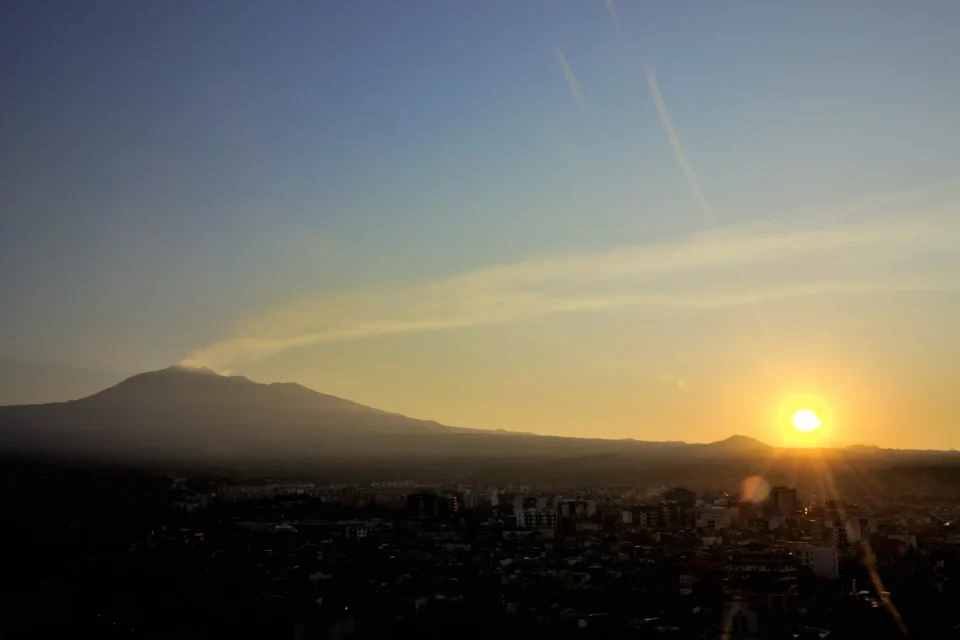
Europe’s tallest active volcano rises above the eastern coast of Sicily, smoking gently one week and erupting the next. A UNESCO World Heritage site wrapped in the Parco dell’Etna, the mountain offers lunar landscapes, a vast collapsed amphitheatre on its flank and summit tracks walked since antiquity, all within reach of the Ionian coast.
Why visit
Etna is not scenery you look at; it is a landscape you walk into. UNESCO inscribes it as the highest Mediterranean island mountain and the most active stratovolcano in the world, a place whose documented activity stretches back at least two thousand seven hundred years and whose behaviour still shapes the science of volcanology. Visitors come for the textures no photograph quite delivers: fields of wrinkled black lava, craters steaming at the summit, birch and pine colonising older flows, vineyards clinging to the fertile slopes below. Two features define the high mountain. The Valle del Bove, a vast horse-shoe depression on the eastern flank, exposes the volcano’s inner history in layer upon layer of solidified rock. Higher still, near the summit zone, the site of Torre del Filosofo marks where walkers once paused on the edge of the craters. Whether you ride part way and stroll, or climb towards the top with a mountain guide, Etna leaves a lasting impression of a planet still at work.
Character and history
The mountain has been written about since the Greeks, who placed the forge of Hephaestus beneath its craters and named its philosopher admirer: the tower site on its flank carries the legend that Empedocles watched eruptions from here. Its eruptions are among the longest documented on Earth, and its lava has repeatedly reshaped the human geography of eastern Sicily, burying fields, diverting rivers and once, in 1669, reaching the walls of Catania. The Parco dell’Etna, created by regional decree in March 1987 as Sicily’s first protected park, covers roughly fifty-nine thousand hectares and balances conservation with the farming communities that harvest pistachios, apples and wine grapes from the volcanic soils. In 2013 UNESCO inscribed the strictly protected upper massif, nineteen thousand two hundred and thirty-seven uninhabited hectares, as a World Heritage site, citing Etna’s exceptional eruptive activity and its importance as an outstanding example of ongoing geological processes. Activity continues: summit craters steam almost continuously, and flank eruptions, monitored closely by the national volcanology institute, periodically redraw the summit landscape.
What to see
The Valle del Bove is the mountain’s great open secret: a colossal scarp-rimmed basin on the eastern flank, formed by catastrophic flank collapse and carved since by eruptive activity, whose walls expose a readable cross-section of Etna’s history. Viewpoints along the road above Zafferana and the Sapienza area look into its vastness, especially beautiful in early morning light. Higher up, the Tower del Filosofo site sits below the summit craters, a historical landmark of high-Etna walking routes, reached only with authorised guides when volcanic conditions allow. Between these two lie the signatures of recent eruptions: hornitos, fissures and fields of weathered lava, crossed by the marked paths of the park.
How to experience
The classic approach is from the south, via Nicolosi to the Sapienza refuge area, where the cable car and authorized jeeps shorten the climb toward the upper craters; from the top station, walking continues only with licensed mountain guides, and the permitted zone shifts with the volcano’s moods. An alternative northern route climbs from Linguagrossa through pine forest to quieter trails around the 2002 craters. Whatever the route, check the current volcanic alert level before setting out, because access to the upper mountain changes with eruptive activity. Dress for two climates: summer heat at the trailheads and near-winter cold and wind at altitude, with sturdy boots and sunglasses. For a gentler day, taste the mountain instead of climbing it, with a wine estate visit among the Etna DOC vineyards on the lower slopes. Stay for dusk if you can; on clear evenings the glow above the summit craters is visible from the coast, a sight locals never tire of.
Practical planning
Etna’s southern access lies about an hour from Catania by car or organized transfer, with buses serving Nicolosi and the Sapienza area mainly in season; the northern side is reached from Linguagrossa or Randazzo. Facilities at the refuges include parking, equipment hire and guide offices, but services thin out fast at altitude. Weather changes quickly above two thousand metres, even in August, so layers are essential; smoke and ash can close roads with little warning. Confirm cable-car operation, guided-excursion availability and access restrictions on the official volcano updates published through the park, parcoetna.it, and the volcanology institute’s Etna observatory pages before travelling. Summer is high season; late spring and early autumn combine stable weather with fewer crowds, while winter brings ski touring on the northern slopes for the properly equipped.
Nearby places
The Sicilian baroque cities of Catania and Acireale frame the volcano on the coast, while the cliff-hung theatre town of Taormina offers perhaps the most famous view of Etna anywhere on the island.
Worth building a day around.
Journeys in Mount Etna.
Demo — Mount Etna Private Highlights Tour
Let a local expert design your Mount Etna day.
Tell us your dates and pace. A travel designer replies within one working day.