Matese
The Matese massif rises between Molise and Campania as a limestone world of karst plateaus, glacial cirques and beech forest, crowned by Monte Miletto at 2,050 metres. Its Molise side gathers mountain resorts, Samnite sanctuaries, a Lombard necropolis with horse burials, hilltop sanctuaries and abandoned borghi into one rewarding circuit.
Why visit
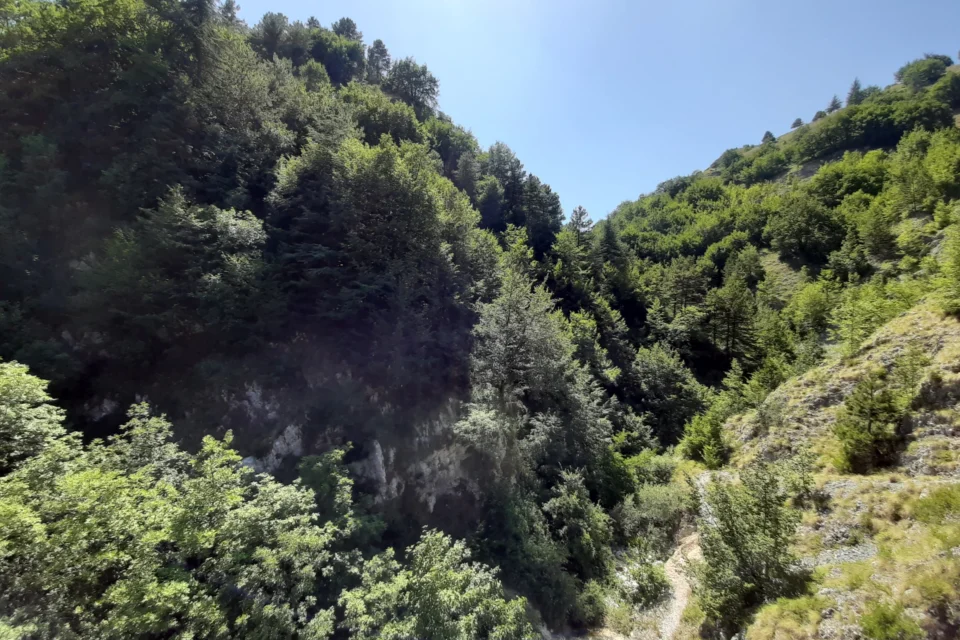
The Matese is where Molise stops being a region of hills and becomes properly alpine. The massif stretches some sixty kilometres along the regional border, a carbonate upland with some of the most striking karst scenery in the Apennines: dolines, canyons, more than eighty mapped caves and the high karst lake of Matese. On the Molise side you can ski or hike at Campitello Matese, descend into the canyons of the Guardiaregia reserve, walk among the remains of an Italic sanctuary of Hercules, and stand at the excavation of a necropolis where seventh-century warriors were buried with their horses. Around the mountains lie Bojano, ancient capital of the Pentri Samnites, and Roccavivara’s beloved sanctuary — a landscape that layers geology, archaeology and living faith.
Character and history
The mountains themselves have deep histories. The rocks formed on a tropical seabed millions of years ago before tectonic uplift raised them into the Apennines; glacial cirques on the highest slopes record the Ice Age, and at Pietraroja, on the Campanian side of the massif, the famous baby dinosaur Scipionyx samniticus — affectionately known as Ciro — was found. Humans arrived early too: Samnite strongholds ringed the massif, and the plain below was among the heartlands of the Pentri.
The early medieval centuries left the area’s most haunting monument. On the Bojano-Sepino plain, the necropolis of Vicenne and nearby Morrione revealed hundreds of tombs oriented west–east, holding men, women and children; about a tenth are knights buried with their horses in a simultaneous burial ritual, accompanied by stirrups and decorative bridle studs of Asian style. Scholars connect this multiethnic community to the account of Duke Alzeco, who led the Bulgars to Italy in 668 and received lands around Sepino, Bojano and Isernia from the Lombards. Later, the Angevin period added watch towers such as Campochiaro’s, and mountain villages grew under castles, some eventually abandoned on their crags.
What to see
The natural anchor is Campitello Matese and Monte Miletto: a plateau resort at around 1,400 metres and the massif’s highest summit at 2,050 metres, from which clear-day views reach as far as the Maiella and Gran Sasso. The regional park manages a network of hundreds of trails, including a multi-day ridge crossing, while winter brings downhill lifts at Campitello and cross-country terrain nearby.
On the karst reserve side, the WWF Oasis and Regional Reserve Guardiaregia-Campochiaro protects canyons, waterfalls and returning wildlife — wolves in the beech woods, golden eagles on the cliffs — and offers equipped routes such as the Gola di Caccaviola for guided visits.
The archaeology is exceptional. The Civitelle Archaeological Area preserves an Italic sanctuary of Hercules dating to the fourth century BC, and the Lombard Necropolis of Vicenne ranks among the most important early medieval sites in southern Italy for its rare horse burials. In Campochiaro itself, the medieval watch tower still surveys the borgo, whose Church of Santa Maria delle Grazie holds one of the finest baroque wooden altars in Molise.
Bojano, the ancient Pentri capital, rewards a half-day: the Cathedral of San Bartolomeo, the Civic Museum of Bojano with its archaeology and paleontology sections, the Church of Santa Maria dei Rivoli built over a Roman temple of Venus, and the ancient Church of Sant’Erasmo in the heart of town. Above the valley lies the abandoned Borgo of Civita Superiore di Bojano with its Lombard castle ruins. In the north, the medieval Sanctuary of Santa Maria di Canneto — a three-naved church with reused Roman columns near the Trigno — stands beside the Roman Villa of Canneto, and Roccavivara’s parish church completes the religious circuit.
How to experience
Choose the season to match the activity: high-summer hiking and paragliding, autumn colours on the beech slopes, and skiing from December to March at Campitello or Bocca della Selva. Birdwatchers favour the Mortine oasis; paddlers take to the lakes; riders and cyclists use the plateau tracks. In Bojano, if your timing is lucky, the annual reenactment of the Ver Sacrum — the Samnites’ “sacred spring,” when young people set out with sacred oxen to found new settlements — fills the streets with period costume. At Roccavivara, ask about the “sagne de la Madonna” tradition, in which the town sends representatives to the sanctuary and welcomes them back with a communal dish. Base yourself in Bojano or Campochiaro for a multi-day loop.
Practical planning
The Molise Matese is reached by road from Campobasso, which has the nearest rail link; distances are short but mountain roads are winding, so allow generous driving time. Facilities vary: Campitello Matese has the fullest range of lifts, rentals and accommodation, while the smaller villages offer guesthouses and agriturismi, best booked ahead in winter and August. Lift operating calendars, reserve access and guided-canyon visits change with the season — confirm with the regional park (parcoregionaledelmatese.it) and the reserve managers before travelling. Weather in the high karst turns quickly at any time of year; carry layers, water and proper footwear even on short walks.
Nearby places
The massif borders several of Molise’s most rewarding destinations: Campobasso, the regional capital with its castle and Misteri tradition, lies just off the northern slopes, and Sepino, whose Roman city sits on the Matese foothills above the Bojano plain, is an obvious pairing with the Vicenne necropolis circuit.
Worth building a day around.
Area archeologica di Civitelle - Santuario italico di Ercole
Guide SLOW Matese: at Civitelle, at 800 m of altitude, the remains of an Italic sanctuary of the 4th century BC dedicated to Hercules…
Borgo di Civita Superiore di Bojano
Guide SLOW Matese: well-preserved ruins of the ancient Lombard castle and charming lanes at Civita; regional sources describe it as an open-air ecomuseum freely…
Campitello Matese e Monte Miletto
Regional tourism portal: ski station and plateau of Campitello Matese in the commune of San Massimo with lifts and slopes on the slopes of…
Cattedrale di San Bartolomeo (Bojano)
Guide SLOW Matese: the cathedral of Bojano, whose building spans over two thousand years of history, open for worship in the town centre.
Chiesa di San Michele Arcangelo (Roccavivara)
Regional tourism portal: parish church edified in the 13th century at Largo Chiesa in the historic centre, open for worship.
Chiesa di Sant'Erasmo (Bojano)
Guide SLOW Matese: very ancient church in the heart of the town, open for worship.
Chiesa di Santa Maria dei Rivoli
Guide SLOW Matese: church built on the remains of a Roman temple dedicated to Venus, open for worship.
Chiesa di Santa Maria delle Grazie (Campochiaro)
Guide SLOW Matese: the church of Santa Maria delle Grazie contains a baroque wooden altar classified as one of the finest in Molise; open…
Museo Civico di Bojano (Palazzo Colagrosso)
Guide SLOW Matese: Palazzo Colagrosso houses the Museo Civico with an archaeology section, a paleontology section, a fossil collection and a Pinto collection of…
Necropoli longobarda di Vicenne
Guide SLOW Matese signals the Lombard-era necropolis at contrada Vicenne near Campochiaro.
Oasi WWF e Riserva Regionale Guardiaregia-Campochiaro
Official WWF page: open every day except Monday all year (closed 25 Dec, 1 Jan, Easter, Easter Monday, 15 Aug); single guided visits, group…
Santuario di Santa Maria di Canneto
Regional tourism portal: church of Santa Maria in Canneto at contrada Canneto, built on an earlier place of worship ceded in 706 AD to…
Torre angioina di Campochiaro
Guide SLOW Matese: the borgo of Campochiaro is dominated by an Angevin tower testifying its medieval past, together with remains of walls and towers…
Villa romana di Canneto
Regional tourism portal: remains of a Roman villa rustica behind the Canneto sanctuary, with mosaic floor sections and large dolia for oil and wine,…
Journeys in Matese.
Demo — Matese Private Highlights Tour
Let a local expert design your Matese day.
Tell us your dates and pace. A travel designer replies within one working day.