Craco
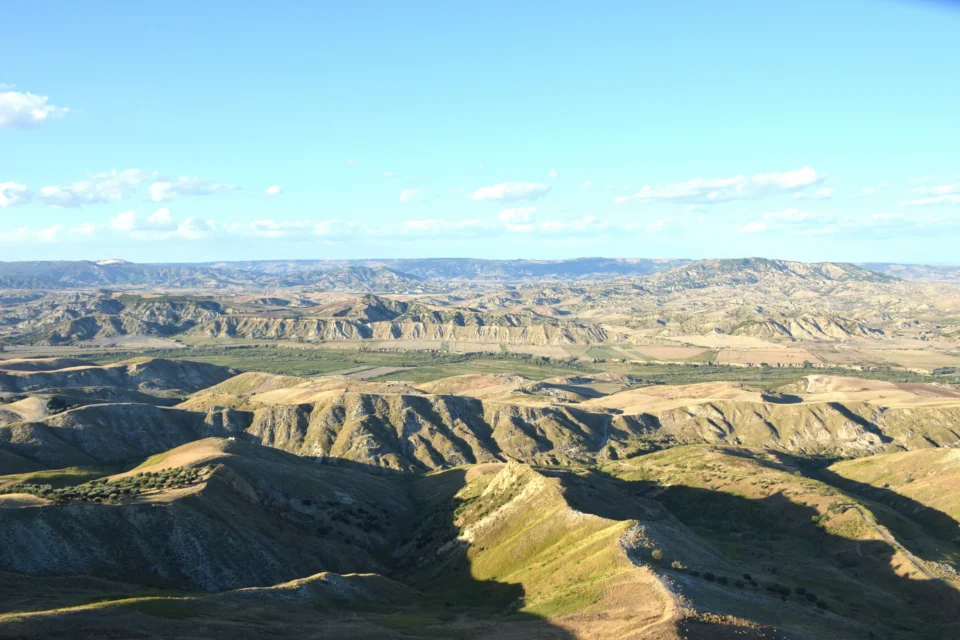
Craco is Basilicata’s famous ghost town: a medieval hilltop borgo abandoned after landslides and evacuated in stages from 1963, its ruined palazzi and Norman tower preserved above the valley. Entry is by guided tour only, along fenced paths where earthquake-shaken houses, calanchi and silence compose one of Italy’s most cinematic landscapes.
Why visit
Craco exists in a category of one. Landslides forced the population down to the valley — the first evacuation order came in December 1963, the last in January 1991 — leaving the old town exactly as it stood, a compact of noble palaces, churches and a Norman tower silhouetted on its clay spur. The regional tourism authority calls the result a “ghost town” whose suggestive ruins, abandoned houses and badlands have made it a film favourite, including Mel Gibson’s *The Passion of the Christ*. What you take away is not a monument list but an atmosphere: empty doorways, caved-in ceilings, a bell tower with no bells. Because entry is possible only on supervised tours, the visit feels closer to an expedition than a stroll — and the short drive to Craco Peschiera below, where the community rebuilt its life, completes a story about abandonment and resilience that few destinations can tell.
Character and history
The borgo’s name — Graculum in Latin — hints at a long occupation of the ridge, crowning a landscape of calanchi where clay continually conspires against stone. The collapse that emptied the town was geological: instability triggered by landslides and a succession of evacuation ordinances moved roughly the whole population into the new quarter of Craco Peschiera in the valley, where the parish and civic life restarted. The old town never lost its magnetism. Pro loco records note the passage from around 1,800 inhabitants in 1963 to the few hundred who rebuilt below; the ridge above was progressively sealed and, in time, opened to controlled tourism. Cinema discovered the site early — besides Gibson’s Passion, numerous international productions have used its skyline — and today the ruins are managed with the same protective logic as an archaeological site, entered on foot with authorised guides along fixed routes. Around the ghost town, the living commune keeps its religious heritage in Craco Peschiera: the Franciscan convent with the church of San Pietro Principe degli Apostoli, built around 1630 outside the old walls, the mother church of San Nicola with its monumental entrance, and the seventeenth-century church of the Madonna della Stella.
What to see
The tour of Craco Vecchia takes in the Norman tower remains, the rows of deserted houses and the noble palaces — the Palazzo Grossi, recognisable by its floral frescoes, and the monumental Palazzo Carbone. On the living side of the valley in Craco Peschiera, two assigned monuments anchor the visit: the MEC, Museo Emozionale di Craco, presso il Convento di San Pietro, an emotional museum set in the Franciscan convent that interprets the town’s abandonment, and the adjacent Chiostro Convento di San Pietro Craco Vecchia, the old convent cloister that pairs the ghost town’s story with its pre-earthquake religious life. Together they give the ruins below their context — and a place to reflect once the tour is over.
How to experience
Book a guided tour — this is not optional at Craco. The pro loco (prolococraco.it) runs authorised visits to the ghost town on a seasonal pattern, daily in the warm months and on weekends through winter, with occasional evening walks that show the borgo under different light; confirm current times and booking requirements on their page before travelling, since access rules are strict and enforced. Wear sturdy shoes: the tour route involves uneven surfaces and low walls, and parts of the site are fenced for safety. Combine the visit with the valley’s churches and the MEC museum to balance the spectacle with the human story. Photographers should aim for the golden hours, when the clay around the tower turns the colour of terracotta; drone use is subject to operator rules, so ask first. Allow half a day with the museum and convent.
Practical planning
Craco lies in the province of Matera, about an hour and a quarter from Matera city and similar from Metaponto’s beaches; the last stretch climbs a quiet road to the belvedere above the old town. There is no public transport of note — come by car. Summer visits mean heat and little shade on the ridge; bring water. Tickets, times and safety rules change with the season and with site conditions (the borgo is periodically assessed for further instability), so treat the pro loco site as the single source of truth. Pair Craco with Aliano or the Ionian coast for a full day’s loop through the calanchi country.
Nearby places
Aliano, with its own badlands and the Carlo Levi literary park, is the natural twin itinerary. Down on the Ionian shore, Metaponto and Policoro supply beaches and Greek archaeology, while Bernalda makes a convenient lunch and services stop, and Matera anchors the region.
Worth building a day around.
Chiostro Convento di San Pietro Craco Vecchia
APT Basilicata — Basilicata Turistica, in “Chiostro Convento di San Pietro Craco Vecchia - Basilicata Turistica”, identifies Chiostro Convento di San Pietro Craco Vecchia…
MEC | Museo Emozionale di Craco, presso il Convento di San Pietro
APT Basilicata — Basilicata Turistica, in “MEC | Museo Emozionale di Craco, presso il Convento di San Pietro - Basilicata Turistica”, identifies MEC |…
Journeys in Craco.
Demo — Craco Private Highlights Tour
Let a local expert design your Craco day.
Tell us your dates and pace. A travel designer replies within one working day.