Corniglia
The quiet one among the Cinque Terre villages, Corniglia sits on a rocky promontory a hundred metres above the sea — the only one of the five not to touch the water. Wrapped in vineyard terraces and reached by stairways, it keeps the atmosphere of a farming hill town. The climb rewards travellers with rooftop views and rare silence.
Why visit
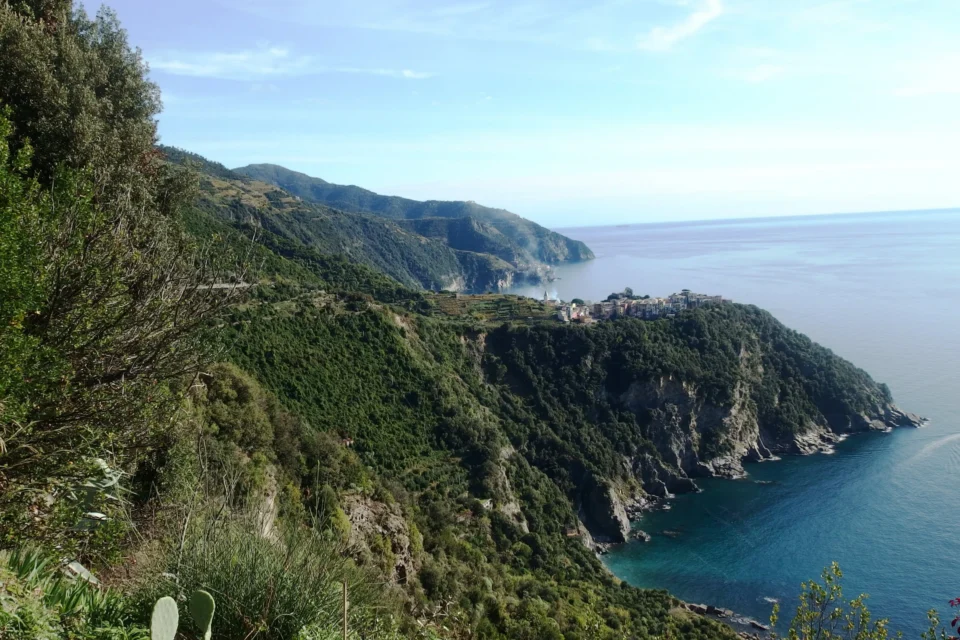
Corniglia suits travellers who want the Cinque Terre without the crush. Because it has no harbour and no beach at its feet, day-trippers thin out, leaving a compact village of narrow alleys and small squares where locals still outnumber visitors by evening. The setting alone justifies the trip: from the panoramic terrace on the seaward tip, the eye runs the whole arc of the coast toward Monterosso and back toward Manarola, high above the murmur of the waves. Add a fine Ligurian Gothic church, a medieval defensive tower and vineyard paths that begin at the village edge, and Corniglia becomes the most contemplative base in the park.
Character and history
Unlike its four neighbours, Corniglia grew from the land rather than the sea, and agriculture — especially the terraced vineyards climbing the slopes on three sides — shaped its fortunes. The village belonged for centuries to the orbit of powerful feudal families, notably the Fieschi, whose influence is still visible in the parish church they rebuilt. The settlement follows a classic Ligurian plan: two main streets crossing at Largo Taragio, the small square where the war memorial stands, with alleys fanning out toward the terraces. Isolation has always been part of its identity; even the railway arrives at the bottom of the cliff, and the village keeps its distance in the most literal way.
What to see
Start at the top of the station climb: the Lardarina Staircase, a historic brick flight of many ramps linking the railway to the village, or take the shuttle bus if you are carrying luggage. At the entrance to the old town stands the Church of San Pietro, a fourteenth-century building in Ligurian Gothic with a striped marble facade and rose windows, raised on the site of an earlier chapel. A short walk brings you to the Oratory of the Disciplinati of Santa Caterina, an eighteenth-century confraternity oratory overlooking Largo Taragio, the main square with its war memorial. On the promontory itself, the Tower of Corniglia (castle remains) preserves part of the old defensive structure. The essential stop is the Terrace of Santa Maria (Largo Terrazzo), a belvedere hanging over the sea where the whole coastline unfolds.
How to experience
Give Corniglia a slow half-day. Climb up from the station on foot, drift through the alleys to the terrace with a coffee, then set out on one of the vineyard paths — the walk toward Volastra and Manarola, or the higher route to the Sanctuary of San Bernardino — both signposted from the village. In late June the feast of St Peter fills the church square with procession and music, and the traditional rice cake, tied to a local legend of the Fieschi family, is shared among neighbours. Winemakers around the village open their cellars in season; ask at the park’s visitor centre or check visitspezia.it for current openings rather than relying on fixed hours.
Practical planning
Corniglia is served by the Genoa–La Spezia railway line; from the small station, either the Lardarina stairs or a frequent shuttle bus takes you up to the village. The Cinque Terre Card covers trail access and can be combined with train travel — buy it online via the national park or at the visitor centres. There is no beach in the village itself, though rocky coves lie at the foot of the promontory for those willing to descend; Guvano and Corniglia’s coves are reached on foot. Summer weekends bring peak crowds on the coastal trail, but Corniglia’s lanes stay noticeably calmer than Vernazza’s or Monterosso’s. Comfortable shoes are essential throughout.
Nearby places
Along the coast, Manarola and Vernazza are the next villages in either direction on the Blue Trail, while Monterosso al Mare anchors the western end with its beaches and Riomaggiore the eastern end. Inland and south, the town of La Spezia offers museums and mainline connections, and the hill villages of the Gulf of Poets begin just beyond it.
Worth building a day around.
Chiesa di San Pietro
Active parish church of the diocesi della Spezia-Sarzana-Brugnato described as the most important monument of Corniglia on the official Visit Spezia tourism portal; identity…
Largo Taragio con Monumento ai Caduti
Wikipedia describes Largo Taragio as the main square holding the Monumento ai Caduti (bronze by Spezia sculptor Enrico Carmassi); Visit Spezia calls it the…
Oratorio dei Disciplinati di Santa Caterina
Listed among Corniglia monuments on the official Visit Spezia portal (18th-century oratory with striking sea view) and described on Wikipedia overlooking Largo Taragio; no…
Scalinata Lardarina
Described on the official Visit Spezia portal as the long brick flight of 33 flights linking the station to the village; step count 377…
Terrazza di Santa Maria (Largo Terrazzo)
Described on Wikipedia as the panoramic terrace at about 90 m above sea level reached via via Fieschi with views over the whole Cinque…
Torre di Corniglia (resti del castello)
Described on Wikipedia (built around 1556 with Fieschi permission against Turkish raids; view of the sea and coast toward Manarola) and consistent with the…
Journeys in Corniglia.
Demo — Corniglia Private Highlights Tour
Let a local expert design your Corniglia day.
Tell us your dates and pace. A travel designer replies within one working day.