Conca dei Marini
Halfway between Amalfi and Positano, Conca dei Marini keeps a lower profile than its famous neighbours — and a deeper history. This whitewashed village gave the world the sfogliatella from its convent, hides a glowing sea cave at its feet, and still keeps a fishermen’s cove reached only by stairway.
Why visit
Conca dei Marini rewards travellers who want the Amalfi Coast at a more human scale. The village spreads down the slope in terraces of white houses, and its sights are compact enough to explore on foot in a morning, yet each one is genuinely distinctive. There is a marine cave whose underwater opening lights the water an impossible green; a former Dominican monastery whose nuns are credited with inventing one of Italy’s most famous pastries; a sixteenth-century watchtower fused to the rock at the cape; and a lower harbour where a handful of boats still work the bay. Between them run stairways, belvederes and short walks with constant views across the Gulf of Salerno. Because the town lacks large hotels and package infrastructure, evenings stay quiet, and the restaurants and cafés along the SS163 serve the people who actually live here as much as the people who are visiting.
Character and history
The name Conca — “basin” or “shell” — is often explained by the shape of the bay where the lower part of the village opens to the sea, and “dei Marini” acknowledges its seafaring families. The UNESCO Amalfi Coast institution records a tradition that ties the village to the “janare”, the folkloric witches said to fly over fishermen’s boats, a reminder of how long superstition and seamanship have mixed along this shore. Its proudest story is culinary: the former convent of Santa Rosa, once a female monastery above the road, is where tradition says the sisters created the sfogliatella, the layered or filled pastry now found in cafés across Italy. Defensive history is written into the cape itself, where a square-plan watchtower commissioned in the sixteenth century under Charles V kept watch against corsairs as part of the coast’s viceregal system. The town’s maritime résumé is old — Conca’s crews sailed in the era when Amalfi’s republic ruled these waters — but the settlement never rebuilt itself for spectacle, which is why its lanes still feel residential and local.
What to see
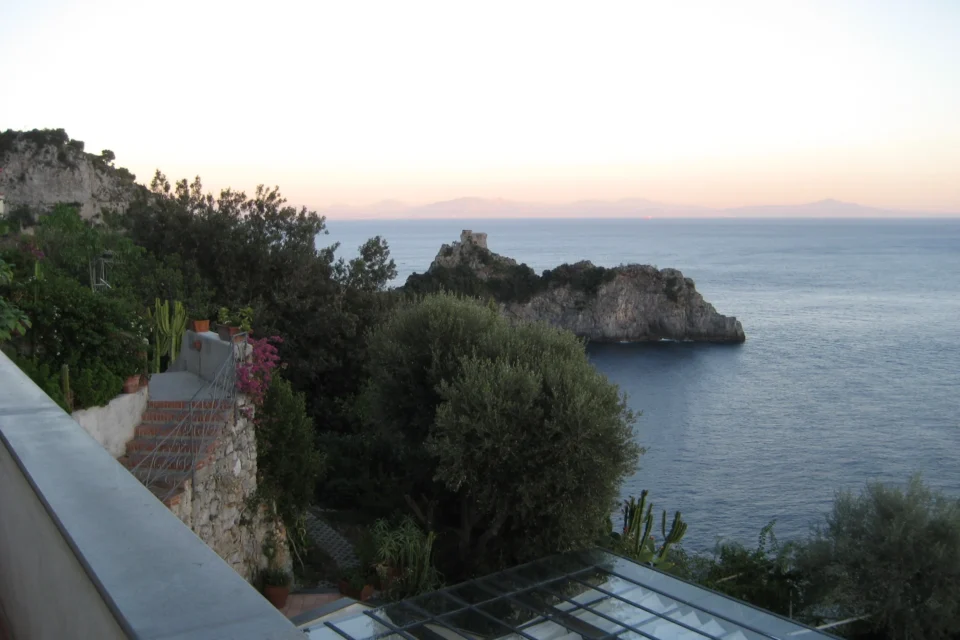
The Emerald Grotto sits at the water’s edge below the village; a fisherman came upon it only in the 1930s, and today visits are by ticketed boat from a small landing, with daylight entering through an submerged opening to flood the chamber in green — conditions and access depend on the sea, so check before going. Higher up, the Monastery of Santa Rosa marks the birthplace of the sfogliatella and now operates as a hotel complex whose architecture retains the convent’s presence above the road. Down at the water, the Fishermen’s village of Marina di Conca is a cluster of boats and bathing platforms reached by about 240 steps from the coast road or by small boat from the sea. On the cape, the Tower of Capo di Conca — a sixteenth-century square tower with three gun emplacements — can be admired from the road at the tip of the promontory.
How to experience
Structure the day around height. Start at the top of the village with coffee and a sfogliatella, in deliberate homage to the convent, then work downhill past the belvederes towards Marina di Conca, timing the descent for midday light on the water. Reserve a grotto visit for when the sea is calm; the emerald effect is a solar phenomenon and shows best in sunshine. Photographers should look back up at the village from the marina at golden hour, when the white houses turn rose. Walkers can continue along the coast path towards neighbouring Praiano for a longer ridge-and-stair itinerary with the gulf in view the whole way.
Practical planning
Conca dei Marini lies directly on the SS163, with Amalfi roughly twenty minutes away by bus and Positano a similar distance west; the municipality’s site, comune.concadeimarini.sa.it, posts current tourism notices. Parking is scarce and mostly roadside, so public buses or boats are the saner choice in season. The marina involves a long staircase — pack accordingly and leave wheeled luggage at your hotel. The grotto, like everything at sea level, is subject to weather closures; the Amalfi tourist portal, visitamalfi.info, carries practical updates. Accommodation is small-scale: convent conversions, guesthouses and villa rentals, best booked well ahead for summer.
Nearby places
The republic’s old capital Amalfi is the closest major town, with its cathedral and Arsenal; beyond it, Minori and Maiori open up the eastern stretch of the coast. To the west, Praiano leads toward Positano along the same shore.
Worth building a day around.
Borgo dei pescatori di Marina di Conca
Official municipal tourism page of the Comune di Conca dei Marini presents Marina di Conca as the picturesque fishermen's borgo of the coast between…
Grotta dello Smeraldo
MAJOR natural site operated as a paid attraction with official pre-sale on the CoopCulture platform (ecm.coopculture.it, referenced by the cave's official Facebook channel) and…
Monastero di Santa Rosa (ex Convento)
UNESCO Amalfi Coast portal: former women's monastery that welcomes visitors at the town's entrance; its Dominican nuns are credited with inventing the sfogliatella (Santa…
Torre del Capo di Conca
Page states: 'La torre è visibile dalla strada' - exterior viewing from the road only, no interior access data.
Journeys in Conca dei Marini.
Demo — Conca dei Marini Private Highlights Tour
Let a local expert design your Conca dei Marini day.
Tell us your dates and pace. A travel designer replies within one working day.