Comacchio
Strung across lagoon channels between the Po and the sea, Comacchio earns its nickname as the Delta’s little Venice: three arched bridges, ochre houses reflected in canals, and a fishing culture so old it has its own museums. This is the capital of the Po Delta park — a town for birdwatchers and pilgrims of properly marinated eel.
Why visit
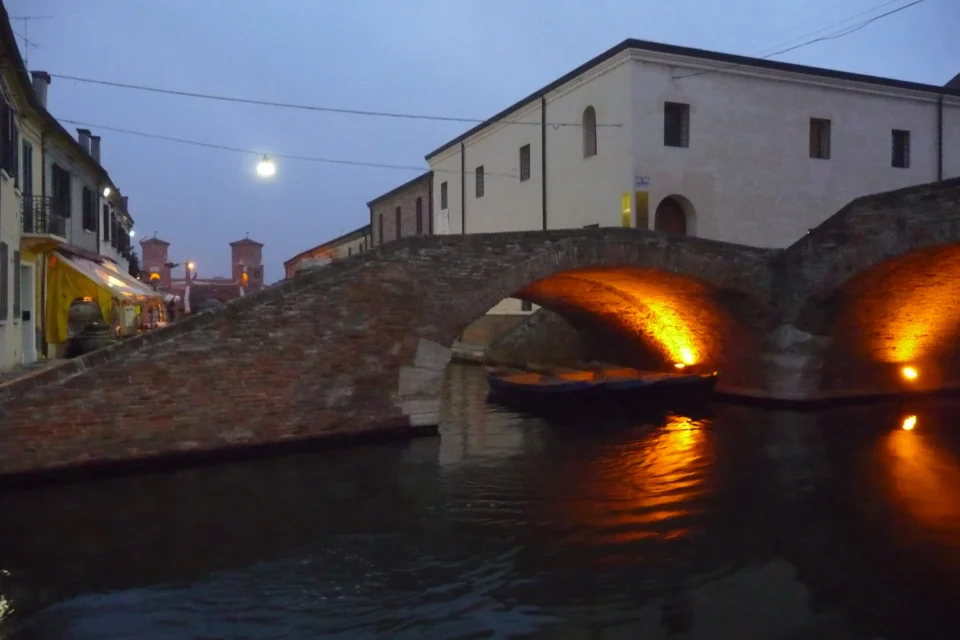
Comacchio looks like no other town in Emilia-Romagna because it is built the way no other town is: on thirteen small islets in the brackish Valli, stitched together by bridges and canals, its centre facing the water on every side. The Trepponti — the five-way staircase bridge that fronts the old hospital — has become one of Italy’s most photographed bridges, and rightly so. But the town’s substance goes deeper than its silhouette. The Museo Delta Antico, installed in that neoclassical hospital, tells two thousand years of the delta’s story from Etruscan Spina to medieval trade, including the astonishing cargo of a Roman merchant ship described as “a true Pompeii of the sea”. Living tradition continues at the Manifattura dei Marinati, where eels are still smoked over twelve hearths, and out in the wetlands, where boat tours drift past flamingos. Between culture and nature, Comacchio is the essential first stop for understanding the Po Delta.
Character and history
Water built Comacchio twice over. The delta’s shifting channels drowned the ancient Etruscan port of Spina — one of the great Mediterranean trading cities whose treasures now surface in the town’s museum — and later stranded a Roman merchant ship with its cargo intact along a coastline that has moved for millennia. The medieval town grew into a trading power of the Adriatic, then passed to the Papal States, which in the eighteenth century endowed it with its most handsome monuments: the Ospedale degli Infermi with its long neoclassical wards, the Trepponti linking five canals at once, and the fish market by the water. Eel made the modern economy: the Valli di Comacchio, vast brackish lagoons, were managed as one of Europe’s great fish farms, and the marinating factories employed generations — a heritage preserved, fires still lit, at the Manifattura dei Marinati. Today the town is the operational heart of the Po Delta park, its streets brushed with the same seaborne light that once drew Greek ships to the Eridano, its seven beach resorts humming a few kilometres away on the coast.
What to see
Start at the water’s edge: the Trepponti, best photographed from the Ponte degli Sbirri, with the old hospital behind it. That hospital building now houses the Delta Antico Museum (former Ospedale degli Infermi), more than two thousand artefacts arranged from Etruscan Spina through Roman delta to medieval emporium — the star exhibit being the cargo of the Roman ship that sank, wrecks and all, along the ancient coast. The Open Air Section of the Delta Antico Museum extends the visit outdoors among the museum park’s installations. Walk on to the Manifattura dei Marinati – Eel Processing Museum on Via Mazzini: the Sala dei Fuochi with its twelve fireplaces, the dock where eel boats unloaded, the vat hall with its barrels, and daily tastings of marinated eel with a glass of local “vino delle sabbie”. Across the lido road at Lido di Spina, the Remo Brindisi House Museum shows the painter’s striking home-cum-museum of twentieth-century art and design, its grounds dotted with sculptures. Between museum stops, enjoy the town itself — the Antica Pescheria fish market, the quiet canals, and the evening bridges.
How to experience
Give Comacchio two days if you can: one for the town, one for the water. Book a boat tour into the Valli from the visitor points at the Stazione or the Valli fishing stations — silent electric boats cross reed beds where flamingos, herons and avocets feed, and guides read the landscape of fish farms that made the lagoon famous. Time a stay for late September and October, when the Sagra dell’Anguilla fills the streets with food stalls and themed menus celebrating the marinated eel in every form, paired with Bosco Eliceo wines from the coastal sands. Eat at the source: grilled eel with polenta, risotto with gilthead, and the delta’s other catches, ideally in a canal-side trattoria. Cyclists get one of Italy’s flattest, richest networks — embankment roads between the lagoons, heron colonies at every bend — and Comacchio’s official billing as a birdwatching city means hides and towers are signposted. Photographers should aim for dawn mist on the Trepponti and sunset from the Ponte degli Sbirri.
Practical planning
Comacchio lies in the province of Ferrara, about 50 kilometres from Ferrara city and 35 from Ravenna; the practical approaches are by car via the coastal road, or by bus from Ferrara (the nearest rail hub is Ostellato/Portomaggiore for local lines). The historic centre is small and flat — everything on foot — with car parks at the gates; bicycles are the ideal second vehicle. Boat tours, the lagoon visitor centres and the museums run reduced schedules from November to March, and some lagoon excursions pause in winter, so check the Po Delta park and museum sites for current openings. The seven lidi offer family beaches from late spring to early autumn. Spring and autumn are the sweet spot — migrating birds, mild cycling weather and the eel festival at the end of September.
Nearby places
Ferrara, the provincial capital and itself a UNESCO city, is the obvious pairing — its Este castle and walls stand less than an hour away — while the wetlands in between are the delta’s own attraction. On the coast side, the beaches of the Comacchio lido string towards Ravenna’s mosaics to the south.
Worth building a day around.
Casa Museo Remo Brindisi
Official tourism pages and Museum Pass inclusion.
Manifattura dei Marinati - Museo della lavorazione delle anguille
Official tourism pages with hours, tariffs, phone 0533 81742.
Museo Delta Antico (Ospedale degli Infermi)
Official museum site with hours/tariffs and official tourism pages.
Sezione Open Air del Museo Delta Antico
Listed by official tourism portal section of Comacchio museums.
Journeys in Comacchio.
Demo — Comacchio Private Highlights Tour
Let a local expert design your Comacchio day.
Tell us your dates and pace. A travel designer replies within one working day.