Colonno
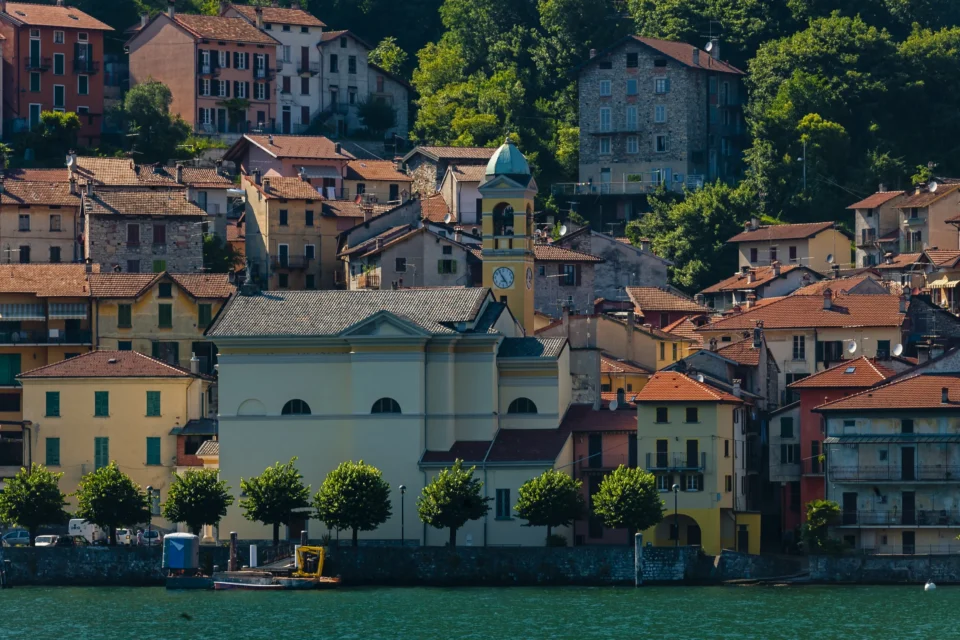
Colonno is one of the small stone villages strung along the Greenway on Lake Como’s western shore, tucked under Monte Costolone between Sala Comacina and Cadenabbia. Split by the old Strada Regina road and laced with medieval lanes, it preserves the plan of its borgo largely intact — a quiet, authentic pause for walkers on the Greenway del Lago di Como.
Why visit
Colonno appeals to travellers who want Lake Como at walking pace. The Greenway, the signposted route that threads the western shore’s villages, passes directly through, and the village rewards the pause: a bridge-house over the Pessetta stream, a sixteenth-century studded door on the old praetorial palace, water falling at the Camoggia waterfall just beyond the houses. It offers none of the villa-and-café infrastructure of Tremezzo or Bellagio — and that is the point. Here you swim off rocks with locals, sleep above a trattoria, and set off on foot to Lenno’s market or the sacred mountain of Ossuccio. Photographers will find the interplay of stone lanes, lake light and terraced hillside endlessly generous.
Character and history
The village’s story is the western shore’s in miniature. Tradition traces its origins to Roman resettlement of the lakeshore, and in the Middle Ages its fortunes were tied to nearby Isola Comacina, the lake’s island stronghold. Feudal lords held it in turn — the Alberti of Colico in the sixteenth century, then the Gallio marquisate of Como from 1640 — and between 1927 and 1950 it was administered together with Sala Comacina and Ossuccio. Ordinary life ran on agriculture and fishing: families farmed terraces built up the slope, and women carried produce for sale as far as Como and Milan on foot. A flood of the Pessetta stream in 1905 is still commemorated by the little bridge-house that spans it, a detail that says much about how closely built and closely memoried these villages are.
What to see
The Historic centre of Colonno is the sight: the medieval street plan survives intact, with narrow lanes, attached houses and small squares opening towards the water, plus the bridge-house over the Pessetta and the Palazzo Pretura with its sixteenth-century studded wooden door. Facing the village’s only lakeside square stands the Church of San Michele Arcangelo, the parish church rebuilt in the nineteenth century on the site of an earlier Romanesque building; traces of the older church remain in the bell tower and in fresco fragments of the fourteenth and fifteenth centuries on the presbytery wall. Above the village, the terraces once farmed up the slopes of Monte Costolone make a short climb with wide lake views.
How to experience
Walk in on the Greenway rather than drive: the route links Colonno with Sala Comacina, Ossuccio, Lenno, Mezzegra, Tremezzo and Griante, and each stage is an easy half-day with villages and viewpoints in between. Pause at the waterfall near the village edge, then take the lanes uphill through the terraces for the panorama before continuing to the sacred mountain chapels at Ossuccio or the market at Lenno. Swimming spots along this stretch are rocky and public; arrive early in summer. The village suits a base for several nights if you prefer self-catering and one good dinner a night over sightseeing checklists. In the evening, the sound is water and church bells — plan to do very little.
Practical planning
Colonno lies on the SS340 Strada Regina, roughly midway between Como and Menaggio; buses along the shore stop nearby, and the mid-lake ferries at Cadenabbia or Lenno put the village within an easy walk or short ride. Parking is scarce and roadside, so visitors without accommodation parking should plan around the Greenway on foot. There are no major ticketed sights — the church opens for worship and visiting at variable hours, best confirmed through the parish or the Diocese of Como. Summer brings the crowds to the lake but leaves Colonno comparatively still; spring and autumn are ideal for walking the Greenway. Bring sturdy shoes: lanes are steep and stepped.
Nearby places
On foot or by ferry, the neighbours are the heart of the mid-lake: Sala Comacina next door, Ossuccio with its sacred mountain, Lenno and its lakeside piazza, Tremezzo and Griante beyond, with Cadenabbia across the water’s edge for the ferry crossing. All are same-province candidates from the context list and all are reachable on the Greenway or its ferry links.
Worth building a day around.
Chiesa di San Michele Arcangelo
Annuario ufficiale Diocesi di Como (indirizzo e culto); scheda BeWeB/CEI n. 14300 (impianto esistente nel XIII secolo, restauri 1570); ricostruzione ottocentesca sopra l'edificio romanico…
Nucleo storico di Colonno
Pagina ufficiale 'Il borgo di Colonno' del portale Greenway del Lago di Como: borgo di partenza del percorso con pianta medievale, Palazzo Pretoria (portone…
Journeys in Colonno.
Demo — Colonno Private Highlights Tour
Let a local expert design your Colonno day.
Tell us your dates and pace. A travel designer replies within one working day.