Brunico
A small Alpine town in the Val Pusteria that pairs a beautifully preserved medieval core with a big-mountain backdrop, Brunico works equally well as a destination in its own right and as a base for the Kronplatz plateau. Two Reinhold Messner museums, a hilltop bishop’s castle and a promenade along the Rienz give it unusual depth for its size.
Why visit
Brunico holds roughly 17,000 people at 835 metres on the Rienz river, and the local tourism board has long billed it as South Tyrol’s most liveable small town — a claim the streetscape does much to support. Where many Alpine centres surrender to traffic, the Old Town of Bruneck (Stadtgasse and the bastions) keeps its painted merchant houses, arcaded lanes and a shopping street regularly ranked among the loveliest in the region. Above it all rises the Bruneck Castle on its hill, and behind it the broad shoulder of Kronplatz, whose summit museums and viewpoint terraces are a cable car away from the Reischach quarter. The result is a town you can cross on foot in fifteen minutes yet stay in for a week: art and mountain culture indoors, hiking and skiing from the doorstep, and enough cafes, bakeries and taverns to make the evenings count.
Character and history
The town’s founding date is unusually precise. Around 1250 Bishop Bruno von Kirchberg of Brixen raised a fortress on the hill above the Rienz valley, and the settlement of traders and craftsmen grew in its shadow on the valley floor — commerce below, ecclesiastical power above, a hierarchy still legible in the townscape. The prince-bishops of Brixen later used the castle as a summer residence, and the town prospered as the market centre of the Val Pusteria.
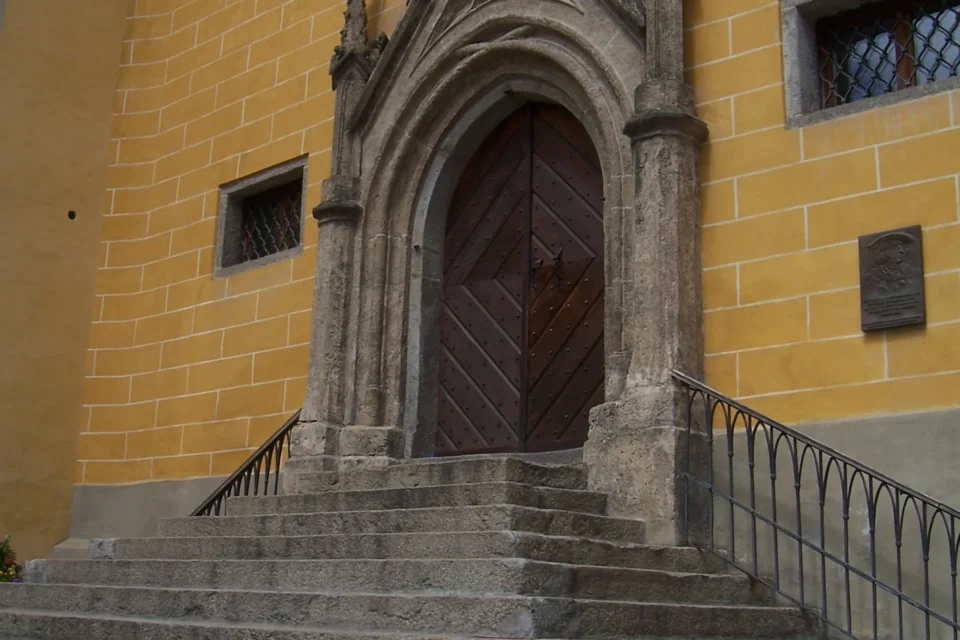
Brunico’s layered history shows in its parish life and its quiet memorials. The Gothic Parish Church of Saint Mary of the Assumption anchors one end of the old town, while the Capuchin Church and the small pilgrimage chapel of Kappler Stöckl mark the wooded hill of the Kapuzinerberg. At the town’s edge, the Forest Cemetery with the Austro-Hungarian cemetery recalls the First World War front that ran through these mountains. The twentieth century brought both borders and tourism; the twenty-first brought renewal, with the castle reborn as a museum and the Town Hall Square (Rathausplatz) redesigned as the town’s contemporary living room.
What to see
Start with the castle. Bruneck Castle crowns its hill above the roofs, and inside its walls Reinhold Messner’s MMM Ripa (Messner Mountain Museum Ripa) is devoted to the mountain peoples of five continents — the name combines the Tibetan words for mountain and person. Exhibits range from recreated dwellings from Nepal, Peru and Morocco to ritual objects, clothing and recorded voices, assembled from some twenty-five high-altitude cultures.
In town, the ECK Museum of Art (Bruneck Civic Museum) traces sacred and late-Gothic painting through to contemporary work, and the conventual Ursuline Church and Convent adds another thread to the old town. The modest medieval Saint Catherine’s Church am Rain stands on the path up to the castle, its onion-dome tower one of the town’s favourite silhouettes.
The mountain is a sight in itself. The cable car from Reischach climbs the Kronplatz (Plan de Corones) Brunico side, where the MMM Corones (Messner Mountain Museum Corones) — a concrete and glass wedge by Zaha Hadid sunk into the summit rock at 2,275 metres — surveys 250 years of alpinism, and the neighbouring LUMEN — Museum of Mountain Photography celebrates the alpine image, while the Concordia 2000 Peace Bell rings from the summit. In the hamlet of Dietenheim, the open-air South Tyrolean Folklore Museum reconstructs rural life in farmhouses and workshops brought from across the region.
How to experience
Give the old town a slow morning: browse the Stadtgasse, linger in Tschurtschenthaler Park, then follow the Tielt Promenade along the Rienz as it curls beneath the castle hill — the classic town walk, shaded and flat. In the afternoon climb to the castle for MMM Ripa, timing the descent for the light on the rooftops.
Reserve a separate day for Kronplatz. In winter the mountain is one of the Dolomiti Superski area’s principal ski hubs; from late spring to autumn the same lifts serve hikers and the summit museums, and the official town programme adds guided walks, cycling, rafting and paragliding for those who want their mountain time organized. Families should pair a museum morning with the folklore museum at Dietenheim, where children can wander between actual farm buildings.
Practical planning
Brunico is served by trains and buses along the Val Pusteria corridor between Bressanone and the Drau valley, and the town is compact enough that a car is optional once you arrive. The castle museums keep seasonal calendars with a long winter break at some sites and summer opening concentrated between May and November — check current schedules before fixing your plan. Summer brings the fullest lift service and the warmest walking weather; winter trades trails for slopes. Book Kronplatz-area accommodation early for February and August, and use the town’s guest programmes, which bundle local transport and activity discounts where available.
Nearby places
Bressanone, with its cathedral and monastery quarter, lies a short train ride down the valley; Bolzano is the provincial capital with the archaeology museum. To the east, Dobbiaco and San Candido open the way toward the Dolomites, while Corvara and Alta Badia sit over the pass to the south.
Worth building a day around.
Campana della Pace Concordia 2000
bruneck.com la lista tra i punti panoramici ('peace bell high above on the summit plateau', stato Open); suedtirolerland.it la descrive come campana della pace…
Castello di Brunico
bruneck.com (turismo ufficiale della città) documenta il castello fatto costruire intorno al 1250 dal vescovo Bruno di Kirchberg, oggi sede del MMM Ripa, aperto…
Centro storico di Brunico (Via dei Mercatini e Bastioni)
bruneck.com presenta la Stadtgasse come 'una delle vie dello shopping più belle dell'Alto Adige' al cuore della città; suedtirolerland.it descrive le case medievali affrescate…
Chiesa dei Cappuccini
Listata tra i luoghi di culto visitabili dal portale turistico ufficiale bruneck.com (sezione sights). Non specificato nelle fonti consultate.
Chiesa di Santa Caterina am Rain
Il portale regionale ufficiale suedtirolerland.it la descrive come la chiesa più antica entro le mura, con imponente campanile a cipolla, simbolo della città insieme…
Chiesa e convento delle Orsoline
Il portale regionale ufficiale suedtirolerland.it cita la chiesa e il convento delle Orsoline nel percorso del centro storico. Non specificato.
Chiesa Parrocchiale di Santa Maria Assunta
Sito ufficiale della parrocchia (pfarrei-bruneck.it, pagina chiese e orari delle messe, indirizzo Oberragen 22); il portale regionale suedtirolerland.it colloca la chiesa parrocchiale nel centro…
ECK Museum of Art (Museo Civico di Brunico)
Sito ufficiale eck.museum; scheda del portale regionale ufficiale suedtirolerland.it con indirizzo, storia (museo civico dal 1912, riaperto 1995 nell'ex stazione di posta, ridenominato ECK…
Kappler Stöckl
Listata dal portale turistico ufficiale bruneck.com tra i luoghi religiosi della città. Raggiungibile a piedi con passeggiata panoramica sul colle.
LUMEN — Museo della fotografia di montagna
Listato da bruneck.com tra i musei del Plan de Corones ('museo dedicato alla fotografia di montagna'). Presso la stazione a monte della cabinovia; chiusura…
MMM Corones (Messner Mountain Museum Corones)
Sito ufficiale MMM: MMM Corones 'alpinismo nella sua essenza' è uno dei sei musei, sulla vetta del Kronplatz; bruneck.com lo lista tra i musei…
MMM Ripa (Messner Mountain Museum Ripa)
Sito ufficiale dei Messner Mountain Museums: MMM Ripa al Schloss Bruneck è uno dei sei musei, dedicato ai popoli di montagna del mondo; bruneck.com…
Museo degli usi e costumi del Tirolo del Sud (Dietenheim)
Listato da bruneck.com tra i musei ('in Dietenheim, riflette modi di vita del passato'); Dietenheim è frazione del comune di Brunico. Comprende edificio museale…
Parco Tschurtschenthaler
Citato dal portale regionale ufficiale suedtirolerland.it. Parco pubblico all'estremità bassa del centro storico.
Passeggiata di Tielt (lungo la Rienza)
Listata dal portale ufficiale bruneck.com tra i landmark della città; suedtirolerland.it descrive la passeggiata lungo la Rienza. Sentiero urbano pianeggiante pubblico.
Piazza del Municipio (Rathausplatz)
suedtirolerland.it la descrive ridisegnata negli ultimi anni e sede di concerti. Piazza pubblica.
Plan de Corones (Kronplatz) versante di Brunico
bruneck.com e suedtirolerland.it presentano il Plan de Corones (accesso da Reischach/Riscone, frazione di Brunico) come la più grande area sciistica dell'Alto Adige e montagna…
Waldfriedhof con cimitero austro-ungarico
bruneck.com descrive il Waldfriedhof come 'cimitero boschivo storico ai margini della città'; suedtirolerland.it ricorda il cimitero austro-ungarico tra i luoghi cittadini. Area cimiteriale storica…
Journeys in Brunico.
Demo — Brunico Private Highlights Tour
Let a local expert design your Brunico day.
Tell us your dates and pace. A travel designer replies within one working day.