Bobbio
Where the Trebbia river leaves the Apennine foothills for the Po plain, a humpbacked medieval bridge leads into one of northern Italy’s most storied small towns. Bobbio grew around an Irish monk’s seventh-century monastery, and its abbey, Scriptorium fame and stone lanes still give it the air of a place where books — and saints — mattered.
Why visit
Bobbio compresses an unusual amount of substance into a town you can cross on foot in twenty minutes. The Abbey of San Colombano is ranked by the municipality among the most important monastic centres in Europe, and its crypt keeps a twelfth-century mosaic and the saint’s sarcophagus. Outside, the Ponte Gobbo strides across the Trebbia on eleven irregular arches — the town’s emblem and its best-loved photograph. The setting does the rest: the municipality promotes the surrounding Val Trebbia for hiking, canoeing and river beaches, in a valley Ernest Hemingway is credited with calling the most beautiful in the world. Add a hilltop castle with a state museum, a Romanesque duomo with its own diocesan museum, Franciscan cloisters and a calendar that runs from classical music to a film festival, and Bobbio earns far more than a lunch stop on the road between Piacenza and the Ligurian coast.
Character and history
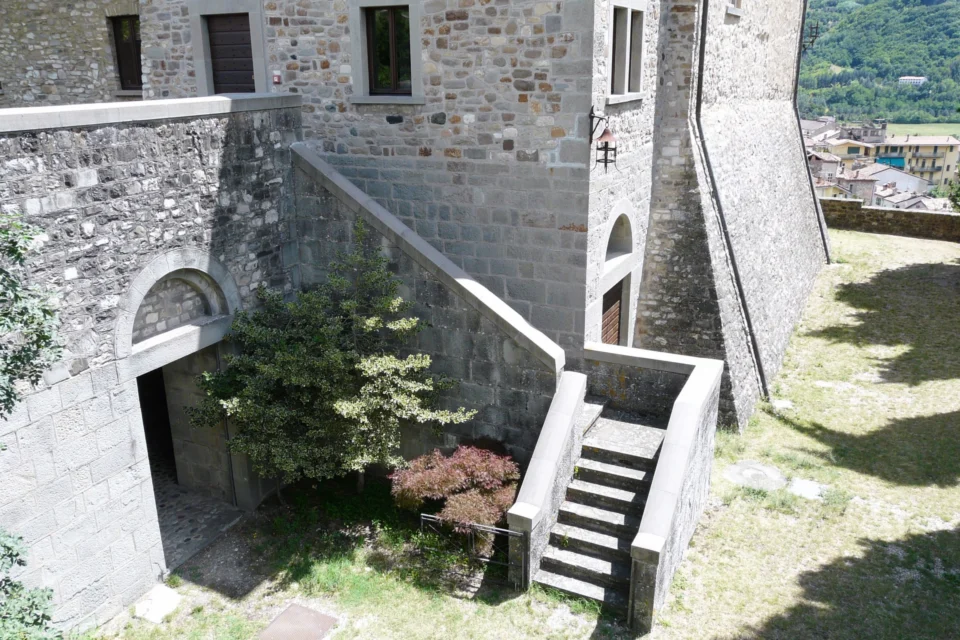
The town’s story begins in 614, when the Irish missionary Columbanus, given land by the Lombard king Agilulf, settled beside an existing church of San Pietro; the original monastery stood where the castle rises today. Under Abbot Agilulfo in the late eleventh century the community moved to its present site, and between 1456 and 1522 the basilica took its current form. In the early Middle Ages Bobbio’s scriptorium and library were among the richest in Europe — by the tenth century the abbey held some 700 codices — and manuscripts copied here, such as the Bobbio Jerome, rank among the earliest surviving Latin books. Umberto Eco drew partly on this monastery for The Name of the Rose. After suppression under French rule in 1803, the abbey’s books were dispersed, but the town kept its scholarly, slightly grave character: clerical colleges, convents and the bishop’s palace line streets that climb from the river towards the castle. The castle itself, begun around 1304 by Corradino Malaspina and reshaped by the Dal Verme family into an elegant residence by 1545, passed to the Italian state and now guards the upper town.
What to see
Begin at the Abbey of San Colombano on the square of the same name. The basilica’s sober nave carries frescoes by Bernardino Lanzani dated 1526–30; below the main chapel, the crypt holds the fine twelfth-century mosaic of the struggle between good and evil and a calendar zone, together with the sarcophagus of San Colombano and Lombard slabs of the early abbots Attala and Bertulfo. The complex gathers three museums: the Abbey Museum of San Colombano with archaeological material and works tied to the saint, the Museum of the City of Bobbio in the former refectory, and the Mazzolini Museum of twentieth-century art. Down by the river stands the Ponte Gobbo (Hunchbacked Bridge), its uneven arches the subject of a devil legend and the best short walk in town. On Piazza Duomo, the Co-Cathedral of Santa Maria Assunta shares the square with the Diocesan Museum of Bobbio in the bishop’s palace. Climb to the Malaspina-Dal Verme Castle, whose keep and halls now form a state museum. Round out the town with the Church and Monastery of San Francesco on the Franciscan route, the Sanctuary of the Madonna dell’Aiuto just outside Porta Nova, and the former Convent of Santa Chiara, now the town’s cultural centre.
How to experience
Cross the Ponte Gobbo early, when the river mist still hangs over the stones, and take the path on the far bank to look back at the arches’ uneven profile. Then work uphill through the borgo: Piazza San Francesco, the shop-lined Via XXV Aprile, and the castle at the top for the widest roofline views. Book lovers should ask at the tourist office in Piazza San Francesco about the abbey’s Scriptorium displays, and browse the second-hand stalls that recall the town’s bibliophile past. The Trebbia is the afternoon’s counterweight — swimming and canoe spots lie minutes from the centre, and the road to Passo Penice climbs to open mountain country and the sanctuary on Monte Penice. Time a trip around the cultural calendar if you can: the Bobbio Film Festival associated with the town’s own director Marco Bellocchio, classical music weeks and autumn food fairs all animate the squares. Try the local table: maccheroni di Bobbio, snails in the traditional style, and wines from the surrounding hills.
Practical planning
Bobbio sits in the province of Piacenza, reached by road over winding Apennine roads — about an hour from Piacenza city and a long but scenic drive from Genoa or the Ligurian coast; there is no railway, so buses from Piacenza or a car are the practical options. The tourist information office (IAT) is on Piazza San Francesco. Museums keep staggered opening days — the castle, for instance, has closed on Tuesdays in recent schedules — so check the municipality’s tourism pages before setting out. Cobblestones and stepped lanes call for sturdy shoes; the bridge is easily walked. Late spring and September suit the valley best, with warm river days and quieter roads; summer brings river bathers and festival crowds to the small historic centre.
Nearby places
Within the province, Piacenza supplies the nearest rail hub plus its own artistic rewards, while Castell’Arquato — another hilltown of the Piacenza Apennines with a fortress and Romanesque collegiate church — makes a natural pairing on aVal d’Arda loop. The Val Trebbia itself, with river beaches and villages such as Travo and Ottone, unfolds upstream from town.
Worth building a day around.
Abbazia di San Colombano
Comune di Bobbio official page: basilica open daily 07:00-19:00, free entry, crypt with tomb of San Colombano and 12th-century mosaic visitable. Basilica accessible from…
Castello Malaspina-Dal Verme
MiC regional museums page: ticketed museum (4 EUR full, 2 EUR reduced, seasonal hours Thu-Mon, daily Jul-Sep); managed by the Municipality of Bobbio since…
Chiesa di San Lorenzo
Listed among Bobbio's churches by local institutional tourism itineraries (QrTour/TurismoQR); feast of San Lorenzo celebrated 8 August per Diocese of Piacenza-Bobbio calendar. Current opening…
Chiesa e Monastero di San Francesco
Comune di Bobbio (updated 2024-12-11): complex visitable from exterior only; services Sat/Sun. Touring Club 'Aperti per Voi' volunteers run guided openings of the basilica…
Concattedrale di Santa Maria Assunta (Duomo di Bobbio)
Visit Piacenza (official provincial tourism) and ColliPiacentini: Duomo open daily 07:00-19:00, free; built from 1073 under bishop Guarnerio; frescoed dome and Cappella del Santissimo.…
Convento di Santa Chiara
Local institutional tourism itineraries (QrTour) and municipal information: the former convent hosts the Municipality's cultural services (Archivio storico, Biblioteca Civica, auditorium Santa Chiara), open…
Museo dell'Abbazia di San Colombano
Comune di Bobbio lists the museum inside the abbey; ColliPiacentini reports ~3 EUR admission and daily opening within complex hours 07:00-19:00. Within the abbey…
Museo della Città
Comune di Bobbio: museum inside the abbey complex; ticketed (reported 6 EUR full / 4 EUR reduced via local tourism source), seasonal schedule. Reached…
Museo Diocesano di Bobbio
Visit Piacenza: inaugurated 2014, open Sat 10:30-12:30, Sun/holidays 10:30-12:30 and 16:00-18:00, closed November-April, voluntary contribution; contacts provided. Noble floor of the bishop's palace; historic…
Museo Mazzolini
Listed by the Comune di Bobbio as a collection of 20th-century artworks inside the abbey complex; no current opening data published on the page.…
Ponte Gobbo
Iconic symbol of Bobbio crossing the Trebbia with 11 irregular arches; documented by official tourism portal Visit Piacenza (1696 ex-voto in the Museo Diocesano…
Santuario della Madonna dell'Aiuto
Visit Piacenza: open daily 08:00-19:00; built 1621-1641, consecrated 1738, elevated to basilica by Paul VI in 1970; older Chiesa dell'Annunciazione reachable via stairs. Single…
Santuario di Santa Maria in Monte Penice
Fondo Ambiente (I Luoghi del Cuore) and diocesan sources: non-parochial church of the Diocese of Piacenza-Bobbio on the summit of Monte Penice, destination of…
Journeys in Bobbio.
Demo — Bobbio Private Highlights Tour
Let a local expert design your Bobbio day.
Tell us your dates and pace. A travel designer replies within one working day.