Atrani
Atrani folds itself into the gorge of the Dragone river beside Amalfi, a tumble of white houses stacked above a small beach. One of the coast’s most ancient settlements, it keeps the dignity of the maritime republic in a maze of lanes, arches and a moonlit piazza.
Why visit
Atrani offers the Amalfi Coast at the scale of a village walk. Everything of substance — the collegiate church on its promontory, the palatine chapel of the doges, the arcaded square, the little lido beneath the cliff — sits within a few minutes of each other on foot. The town belongs to the UNESCO-listed Amalfi Coast cultural landscape, to the Monti Lattari park, and to the Borghi più belli d’Italia association, yet it keeps a working, residential character that its larger neighbours surrendered long ago. Visitors come for an hour and stay for the evening, when day-trippers thin out and the piazza fills with locals eating under the awnings.
Character and history
Atrani’s story is inseparable from the medieval maritime republic of Amalfi, whose wealth and naval power shaped this coast in the early Middle Ages. The town was effectively Amalfi’s noble quarter and ceremonial stage: its dukes and doges were crowned on the parvis of San Salvatore de’ Birecto, the former palatine chapel that still stands over Piazza Umberto I, and a street named Via dei Dogi still threads the quarter. The municipality keeps that memory alive today with the Premio Atrani – Magister di Civiltà Amalfitana, an award echoing the republic’s own honours. Geography explains the town’s tight form: it sits in the valley of the Dragone — the river of dragon legend — squeezed between Monte Civita and Monte Aureo, so houses climb the ravine walls in stairs, alleys and covered arches rather than spreading outward. A cluster of churches and former monastic buildings marks the promontory separating Atrani from Amalfi’s harbour, crowned by the collegiate church of Santa Maria Maddalena.
What to see
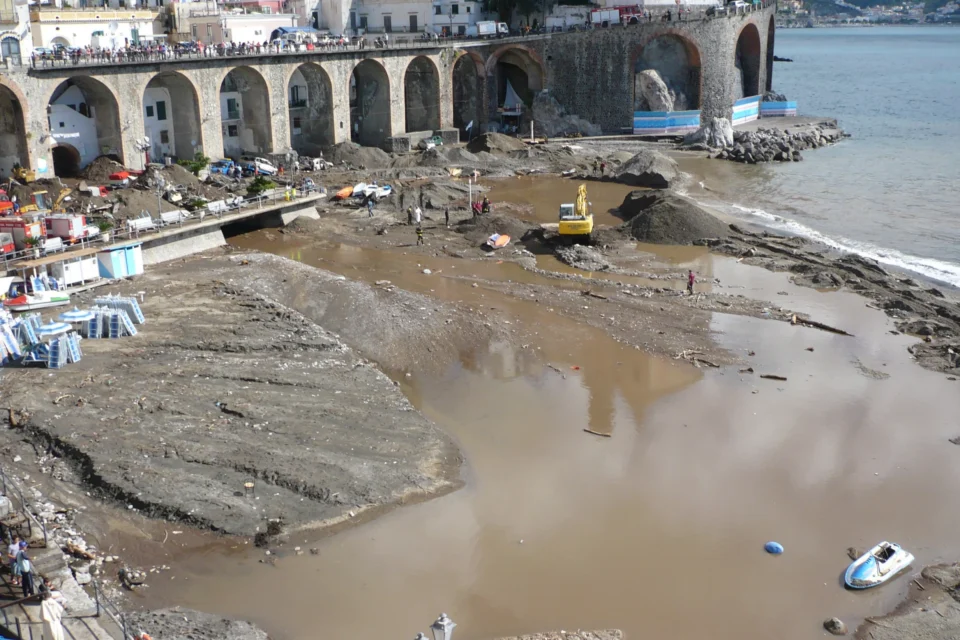
Begin at Piazza Umberto I, the ring of arcades and cafés that serves as the town’s living room, overlooked by the Church of San Salvatore de’ Birecto, whose courtyard saw ducal coronations in the age of the republic. Cross the footbridge lanes up to the promontory for the Collegiate Church of Santa Maria Maddalena Penitente, a baroque landmark with a tiled dome and bell tower raised where a medieval stronghold once watched the sea. Between monuments, the town itself is the sight: whitewashed stairways, ceramic street shrines, and an open-air display of ceramics by master potter Lucio Liguori that the municipality presents as a museum without walls. Below, a small beach rests under the railway arch at the mouth of the valley.
How to experience
Atrani is best experienced slowly and on foot, ideally as a base rather than a stop. Arrive by ferry or bus from Amalfi — the walk along the coast road takes minutes, but arriving by sea frames the stacked town properly. Swim early at the lido before the boats, then spend the middle of the day in the churches when the light hits the majolica domes. Return to the piazza in the evening for dinner among residents, and finish with the short, stepped walk up the hillside paths for the classic view of rooftops over the sea. The municipality’s site (comune.atrani.sa.it) lists cultural events, concerts and the ceremonies that animate the square through the year.
Practical planning
Atrani has no car park of consequence; the coast road is best left to buses and the ferries that link it with Salerno, Amalfi and Positano in season. Schedules shift with the calendar, so check current connections and any municipal notices at comune.atrani.sa.it before travelling. Pack shoes for stairs — every part of the town involves steps — and expect the beach to be small and busy at the height of summer. Restaurants cluster around the piazza; booking is wise on summer weekends. For walking the higher trails toward Ravello or the Valle del Dragone, carry water and set out early in the warm months.
Nearby places
Amalfi’s cathedral and harbour are next door: Amalfi. The hillside town of gardens and villas sits directly above: Ravello. The vertical village of Furore and the fishing harbours of Minori and Cetara lie along the same coast.
Worth building a day around.
Chiesa di San Salvatore de' Birecto
Official municipal pages: the palatine chapel where the Dukes of Amalfi were invested with the 'birecto'; its parvis (sagrato) hosts public civic and religious…
Collegiata di Santa Maria Maddalena Penitente
Official municipal history page states the church 'oggi sorge' on the promontory where the Castello di Supramonte stood; functioning collegiate church of the Diocese…
Piazza Umberto I
Official municipal site cites Piazza Umberto I as the venue of public concerts and civic events; the square faces the San Salvatore de' Birecto.
Journeys in Atrani.
Demo — Atrani Private Highlights Tour
Let a local expert design your Atrani day.
Tell us your dates and pace. A travel designer replies within one working day.