Altomonte
Altomonte rises on a spur above the Esaro valley at the edge of the Pollino massif, a compact stone town of arcades, bell towers and long views towards the Sibari plain. One of Calabria’s most distinguished medieval borghi, it pairs a rare Angevin Gothic church with a Norman castle and a summer music festival that fills its open-air theatre.
Why visit
Few Calabrian towns pack so much documented medieval substance into so few lanes. Altomonte sits at around 500 metres on the left side of the Valle dell’Esaro, its houses stacked below a castle rock, with the Pollino mountains closing the horizon. The town is listed among I Borghi più Belli d’Italia, and unlike many listed borghi it earns the title with buildings you can actually go inside: a 14th-century Gothic church of real architectural importance, a castle converted into a hotel, and a Dominican convent whose cloister holds the civic museum and picture gallery. Add the views over the plain towards the Ionian coast and an unusually lively cultural calendar, and Altomonte works as both a day trip and a base for the northern Pollino.
Character and history
The oldest settlement lay closer to the Esaro river, where excavations have brought to light a Roman villa of the first century AD, now within the Larderia archaeological area. Around the year 1000, repeated Saracen raids pushed the inhabitants uphill to the present site. The town’s golden age came under Angevin rule in the 14th century, when the Sangineto family made it one of the leading cultural centres of the Italian South, aided by Dominican friars who remained a presence here until the 19th century. The philosopher Tommaso Campanella was among those who stayed in the convent. Successive lordships — Ruffo, Sanseverino and others — left the castle and tower enlarged but essentially intact, and the historic centre keeps its medieval imprint: steep lanes, stone portals, and churches stacked in a tight cluster at the top of the hill.
What to see
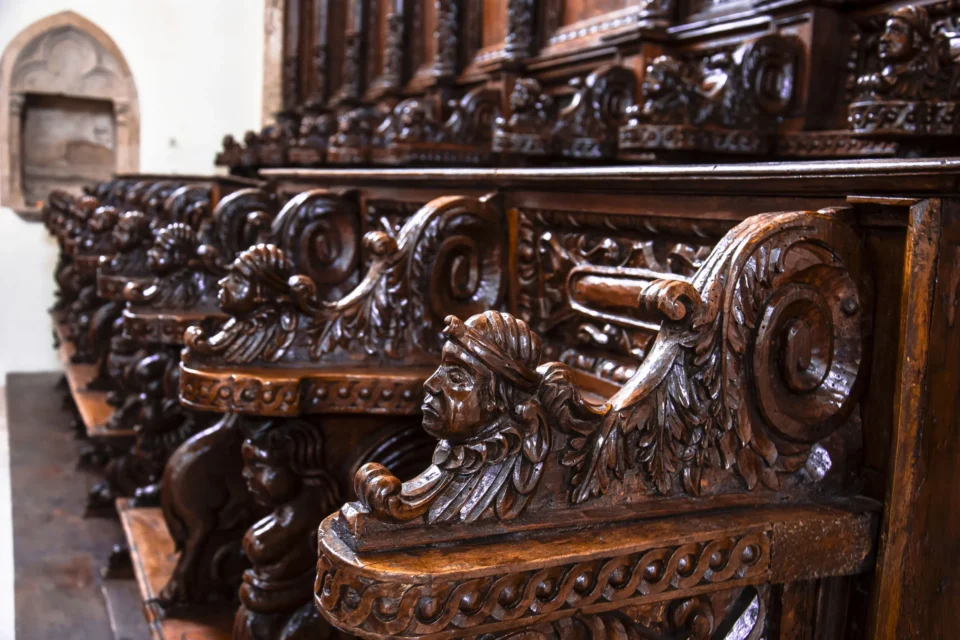
The Church di Santa Maria della Consolazione is the artistic heart of the town and one of the finest examples of Angevin Gothic in Calabria, built in the French-influenced style of the late 14th century; a Latin inscription on its bell dates construction to 1336. Inside are a 15th-century carved wooden choir, the tomb of Filippo Sangineto, Count of Altomonte, and a baroque gilded-wood altar of St Michael. The Castle Normanno di Altomonte was begun by the Normans in the 12th century on a rocky crag and later passed to the Sangineto, Ruffo and Sanseverino families; it now operates as a hotel, but its walls and position still dominate the approach to the borgo. The Historic Centre di Altomonte is the attraction in itself — arcaded streets, the medieval Torre Pallotta with its Gothic bifora window, and the former Dominican convent, whose 15th-century cloister leads to the civic museum, library and modern art collection. The Theatre Costantino Belluscio, inaugurated in 1988 with the first Festival dei Due Mari and later adorned with mosaics on its main facade, anchors the town’s summer season.
How to experience
Come for an overnight stay if you can: the town changes character in the evening, when day visitors leave and locals fill the piazze around Santa Maria della Consolazione. Summer brings the Altomonte Festival Euromediterraneo to the open-air theatre, an established fixture on southern Italy’s music calendar. Walk the full length of the historic centre from the lower gates up to the castle, then continue to belvedere points over the Sibari plain — on clear days the line of the Ionian Sea is visible. Combine the visit with the Pollino landscapes nearby: the Esaro valley roads towards Morano Calabro and Civita are among the prettiest drives in northern Calabria. Food-wise, the surrounding hills produce oils, cheeses and river trout; ask for the local specialty dishes in the small trattorie around the centre rather than planning a formal meal.
Practical planning
Altomonte lies in the province of Cosenza, roughly equidistant from the A2 motorway and the coast; most visitors arrive by car, parking below the historic centre and continuing on foot, as the upper lanes are pedestrian territory. A couple of hours cover the church, castle exterior and centre comfortably; a half-day allows museum time and a long lunch. The tourist office information and current opening arrangements for the museum complex and church are best confirmed on the comune’s official site, comune.altomonte.cs.it, before travelling. Spring and autumn offer the clearest views and mild walking weather; July and August bring the festival crowds but also the fullest programme. Sturdy shoes help — the town is steep.
Nearby places
The Pollino national park begins just to the south, its river gorges and mountain villages an easy outing. Morano Calabro, another of the region’s celebrated hilltowns, and Civita, with its Arbëreshe culture and the Raganello canyon, both make natural pairings to the south-east. For coastal contrast, Scalea and Diamante on the Tyrrhenian shore are under an hour by road, and the city of Cosenza provides the nearest urban conveniences.
Worth building a day around.
Castello Normanno di Altomonte
Regione Calabria — Calabria Straordinaria, in “https://calabriastraordinaria.it/storage/files/02_ARTE%20E%20CULTURA_IT_WEB.pdf”, identifies Castello Normanno di Altomonte as a visitor-relevant attraction associated with Altomonte. Verified source scope: destination identity;…
Centro storico di Altomonte
Regione Calabria — Calabria Straordinaria, in “https://calabriastraordinaria.it/storage/files/02_ARTE%20E%20CULTURA_IT_WEB.pdf”, identifies Centro storico di Altomonte as a visitor-relevant attraction associated with Altomonte. Verified source scope: destination identity;…
Chiesa di Santa Maria della Consolazione
Regione Calabria — Calabria Straordinaria, in “https://calabriastraordinaria.it/storage/files/02_ARTE%20E%20CULTURA_IT_WEB.pdf”, identifies Chiesa di Santa Maria della Consolazione as a visitor-relevant attraction associated with Altomonte. Verified source scope:…
Teatro Costantino Belluscio
Regione Calabria — Calabria Straordinaria, in “https://calabriastraordinaria.it/storage/files/02_ARTE%20E%20CULTURA_IT_WEB.pdf”, identifies Teatro Costantino Belluscio as a visitor-relevant attraction associated with Altomonte. Verified source scope: destination identity; named…
Journeys in Altomonte.
Demo — Altomonte Private Highlights Tour
Let a local expert design your Altomonte day.
Tell us your dates and pace. A travel designer replies within one working day.