Agrigento
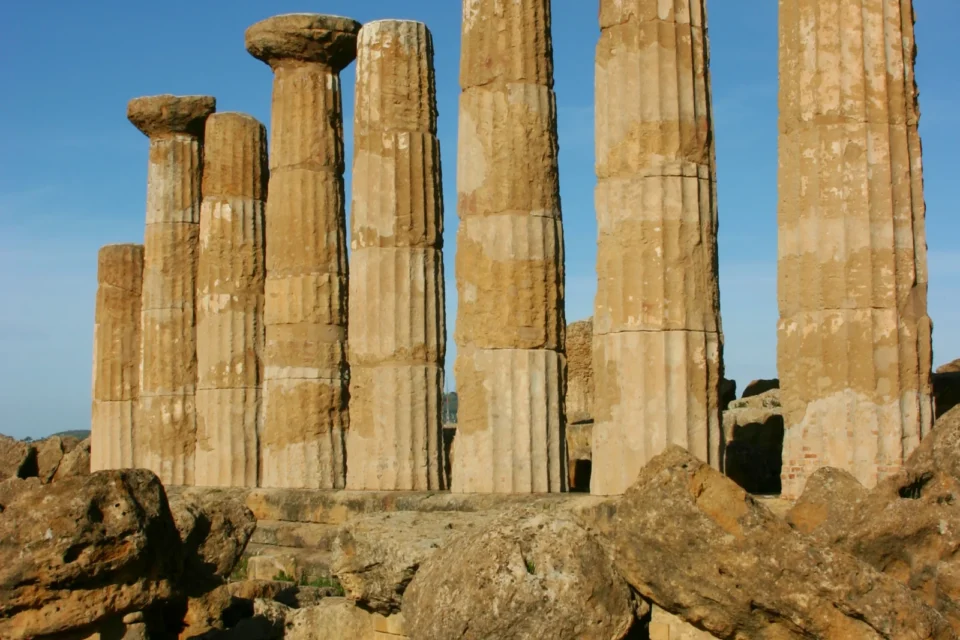
Agrigento stands above one of the great sights of the ancient Mediterranean: a ridge of Doric temples so complete that UNESCO inscribed the whole archaeological area in 1997. The town is more than a gateway: its medieval lanes climb a steep hill, its museum holds a seven-metre Telamon, and its hills grow the almonds celebrated each spring.
Why visit
Few places let you walk a road lined with Greek temples in the morning and sit in a shaded medieval piazza by lunch. Agrigento, founded around 581 BC by colonists from Rhodes and Crete, was among the wealthiest cities of the Greek world, and the temples its citizens raised along the southern ridge still parade across the skyline. The archaeological area is vast — one of the largest parks of its kind anywhere — so you can spend half a day among columns, quarries and garden valleys without feeling herded. The town above adds texture that pure archaeology cannot: Norman-Gothic stonework, a church built over a Greek temple, and the hillside quarters where Pirandello’s characters might have lived. Combine it with the white Scala dei Turchi cliffs nearby and the coast road, and you have one of Sicily’s most complete stays.
Character and history
Akragas, as the Greeks called it, grew rich on grain and trade and became famous for the luxury of its citizens, so much so that the poet Pindar wrote of it admiringly. The Carthaginians destroyed the city at the end of the fifth century BC, yet it rose again under Greek, then Roman rule; Christian centuries layered churches onto the ruins, and the Arabs and Normans left the hilltop town you can still climb. Its long decline into a rural backwater preserved what grander cities lost. In 1997 UNESCO inscribed the Archaeological Area of Agrigento on the World Heritage List, recognising both the temples and the surviving Hellenistic-Roman street grid below them. The city also claims the Nobel laureate Luigi Pirandello, born at Contrada Caos on the edge of town, whose ashes rest there. Since 1934 the Sagra del Mandorlo in Fiore has marked the almond blossom with folk music from across the Mediterranean.
What to see
The temples themselves need little introduction: Concordia, best preserved; Juno on the eastern knoll; Heracles; and the giant Olympieion, whose collapsed Telamon figures now lie assembled in the museum. That museum is the Pietro Griffo Regional Archaeological Museum, in the San Nicola district just below the temples, where the more-than-seven-metre Telamon stands as the centrepiece beside the slender Ephebe of Agrigento and finds that trace the story from prehistory through Hellenisation. In the adjacent medieval church of San Nicola you can admire the carved Sarcophagus of Phaedra, one of the finest Roman reliefs in Sicily. Back in town, the cathedral of San Gerlando and the church of Santa Maria dei Greci — built directly on the podium of a fifth-century BC Doric temple — reward an unhurried afternoon, and the Hellenistic-Roman Quarter preserves villa floors and regular streets of the ancient lower city.
How to experience
Start early: the park opens at daybreak in summer, when the light rakes across the columns and the crowds are thin. Walk the full ridge rather than only Concordia, and drop into the Kolymbetra garden, a former reservoir of the tyrant Theron now a citrus-shaded oasis cared for by the heritage fund FAI. Return to the museum in the hottest hours, then climb to the old town at sunset for a drink with the temples glowing behind you. In February or early March, plan around the almond blossom festival, when folk groups perform below Concordia and a “tripod of friendship” is lit. A car helps for the Scala dei Turchi and Pirandello’s house at Caos, though the temples are reachable on foot from town. Local cooking leans earthy here: rabbit, broad beans, almond pastries and the olive oil of the surrounding hills.
Practical planning
Agrigento is reached by train or bus from Palermo and Catania, each roughly two and a half hours away, or by car on the SS115 and A19; the nearest motorway link makes Caltanissetta a natural stop en route. The archaeological park involves long exposed walks, so bring water, a hat and real shoes. Temporary exhibitions, temple opening hours and the shuttle arrangements inside the park change seasonally — check the regional park authority’s site, parchiarcheologici.regione.sicilia.it, and the Visit Sicily pages before you go. Spring and autumn are the kindest seasons; August afternoons are punishing on the ridge.
Nearby places
Piazza Armerina, over the hills in Enna’s territory, guards the Roman villa whose mosaics are among the finest in the world. Caltagirone keeps its ceramic stairway and pottery workshops within easy reach for a day away. Enna, Sicily’s highest provincial capital, crowns the island’s centre with a castle and sweeping views.
Journeys in Agrigento.
Demo — Agrigento Private Highlights Tour
Let a local expert design your Agrigento day.
Tell us your dates and pace. A travel designer replies within one working day.