Santa Maria di Leuca
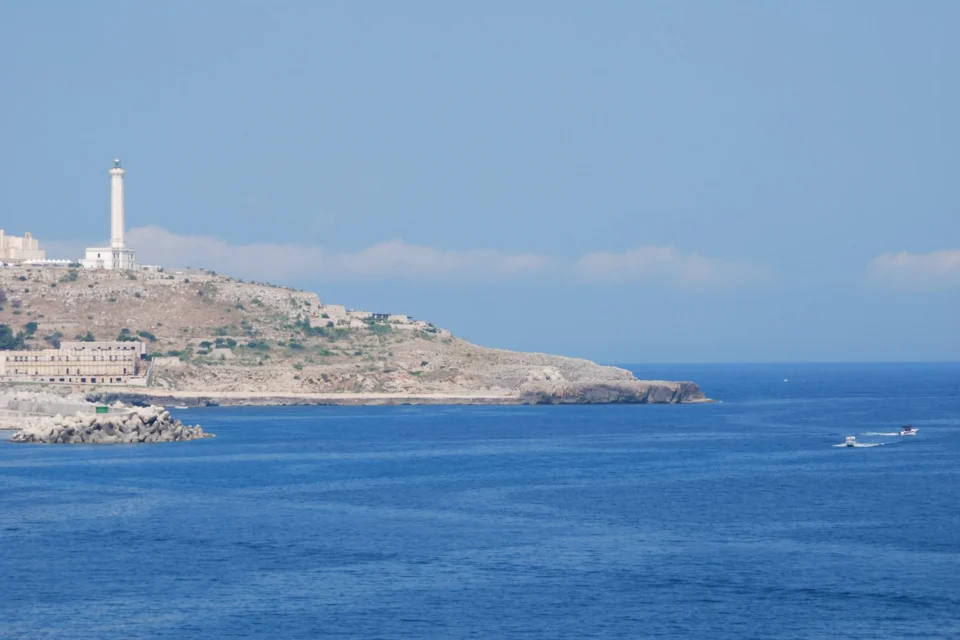
At Punta Meliso, the very heel of Italy, the Adriatic and the Ionian meet in long lines of blue. Santa Maria di Leuca gathers a sanctuary “at the ends of the earth”, one of the country’s great lighthouses, a monumental aqueduct waterfall of 270 steps, and a seafront of fantastical eclectic villas into a single unforgettable horizon.
Why visit
Leuca is less a village than a compass point — the place where Italians come to stand at the bottom of the map. Two differently coloured seas collide off the rocks, fishermen and pilgrims have crossed paths here since antiquity, and the waterfront villas read like a catalogue of exotic styles. Come for the light at dawn or dusk, the swim between the two seas, and the sense of arrival that no other corner of Puglia quite offers.
Character and history
The name descends from the Greek “Leucos”, white or shining, given to the ancient Promontorio Japigio that divides the waters. Tradition holds that St Peter first preached on Italian soil here around 43 AD, and a sanctuary has marked the cape ever since; the present church, the sixth on the site, was rebuilt in the eighteenth century by Bishop Giannelli over the remains of a pagan temple to Minerva, and keeps a Madonna painting by Palma il Giovane. The sanctuary’s own site records its continuing life as a place of pilgrimage — night walks from Alessano, the Cammini di Leuca routes, and papal visits in recent memory.
The nineteenth and twentieth centuries added their monuments: the great lighthouse of 1866 on Punta Meliso, and, in 1939, the monumental cascade built to celebrate the arrival of Apulian Aqueduct water in the dry Salento. Around the little port rose more than fifty villas by 1900 — from ten in 1868 — as aristocratic and bourgeois families turned the cape into a fashionable summer colony.
What to see
The Basilica Sanctuary of Santa Maria de Finibus Terrae crowns the plaza at the top of the waterfall staircase; beside it, the diocesan-parochial Vito Mele Museum collects the sanctuary’s sacred art, and its gardens frame the view over both seas. On Punta Meliso stands the 48-metre Santa Maria di Leuca Lighthouse, 102 metres above the waves, its beam reaching some forty kilometres and counting among Italy’s most important; the Pro Loco arranges visits at set times. Below the basilica, the Monumental Waterfall of the Apulian Aqueduct descends in a double staircase of 270 steps, opened in 1939 and now occasionally illuminated at night, with the monolithic Roman Column of Leuca marking its base. Along the seafront, the Historic Villas of Santa Maria di Leuca parade more than ten architectural styles — the liberty Villa Meridiana, the Arabic-styled Villa Daniele, Pompeian and Ionian villas, the Chinese-inspired Villa Episcopo — while at the northern edge of the bay the sixteenth-century Torre dell’Omomorto remains from the chain of coastal watchtowers.
How to experience
Walk the staircase at golden hour, then take a boat out to the line where the two seas visibly meet — most operators also run into the marine caves of the southern coast. Swim off the rocks at the port in the morning, before the wind turns. Liturgically minded travellers can join the sanctuary’s schedule; it opens early and closes at night, and the pilgrimage routes from inland villages are a tradition in themselves. Evening means fish restaurants around the harbour and the passeggiata under the villas’ lit facades. Visiting hours for the lighthouse and waterfall change seasonally — the Pro Loco’s pages list current times.
Practical planning
Leuca sits at the end of the Salento coast road, about an hour’s drive from Lecce; buses run in season but a car gives you the coves and cave entrances nearby. Summer brings the crowds and the boat traffic; May, June, September and October offer the cape at its most serene. The sea here can be choppy where the currents meet — check conditions before long swims. Parking in July and August requires patience; come early. Confirm basilica opening and Mass times on the sanctuary’s official site and lighthouse visiting windows through the Pro Loco.
Nearby places
Rounding the coast northwards, Castro offers its cliff-set old town and famous grotto, Ugento brings an ancient Messapian town with quiet Ionian beaches, and the white fortified lanes of Specchia lie just inland — three natural companions in the deep Salento.
Worth building a day around.
Basilica Santuario di Santa Maria de Finibus Terrae
Santuario sul promontorio di Capo di Leuca, dove secondo la tradizione sbarco San Pietro; aperto 6:30-21:00 secondo il sito ufficiale della basilica; basilica minore.…
Cascata monumentale dell'Acquedotto Pugliese
Scalinata-cascata di 120 m costruita nel 1939 per celebrare l'arrivo dell'acqua dell'Acquedotto Pugliese nel Salento; attivata eccezionalmente, visitabile dall'esterno con la scalinata verso il…
Colonna romana di Leuca
Colonna d'epoca romana alla base della Cascata monumentale, documento della romanizzazione di Leuca; documentata dalla Pro Loco Leuca.
Faro di Santa Maria di Leuca
Secondo faro piu alto d'Italia (48 m sul promontorio di Punta Meliso, 102 m s.l.m.), attivo dal 1866; visite interne organizzate dalla Pro Loco…
Museo Vito Mele
Museo citato tra le sezioni del sito ufficiale della Basilica Santuario di Leuca; orari e modalita di accesso non pubblicati (unknown).
Torre dell'Omomorto
Torre costiera 'a martello' del 1555 circa (Andrea Gonzaga), oggi rudere; scheda nel Catalogo generale dei Beni Culturali (MiC) con indirizzo Via Fabio Filzi…
Ville storiche di Santa Maria di Leuca
Oltre cinquanta ville di inizio Novecento in stile liberty, arabo, pompeiano e cinese (villa Meridiana, Daniele, Fuortes, Episcopo) lungo il lungomare; fruibili dall'esterno lungo…
Journeys in Santa Maria di Leuca.
Demo — Santa Maria di Leuca Private Highlights Tour
Let a local expert design your Santa Maria di Leuca day.
Tell us your dates and pace. A travel designer replies within one working day.