Sant’Agata de’ Goti
Sant’Agata de’ Goti balances on a shelf of yellow tuff above the Martoro stream, its bell towers and majolica domes crowning houses that seem grown from the rock. Heir to the Samnite city of Saticula, this Touring Club orange-flag town pairs a dense medieval centre with the tuff-carved cellars of Falanghina country.
Why visit
Sant’Agata de’ Goti earns its detour from position alone. The historic centre rides a promontory of volcanic tuff above the gorge of the Martoro stream, near its meeting with the Isclero, and the best introduction is the view from the tall Vittorio Emanuele bridge, which reveals the arches and cliff-edge houses holding the town together. The Touring Club Italiano has awarded the town its Bandiera Arancione for quality tourism and hospitality, an endorsement of the intact medieval fabric rather than a marketing flourish. What awaits inside is unusually rich for a town of this size: a Romanesque cathedral on an ancient site, early twelfth-century church floor mosaics, late-Gothic fresco cycles, and a ducal castle with Baroque painted ceilings. And because this is Sannio wine country, any visit naturally ends underground, among the tuff cellars where the local Falanghina was first bottled as a single-varietal wine.
Character and history
The site descends from Saticula, a Samnite settlement that became a Roman colony after the Second Punic War; a Roman castrum was pitched here in 343 BC during the Samnite wars. The town took its present shape under the Lombards, who held it as a gastaldato of the Duchy of Benevento, and the diocese was created in 970. Under the Normans from the mid-eleventh century the defensive walls, worked into the natural quarries, made the plateau nearly impregnable, and Roger II secured it definitively in 1139. Feudal families — the Della Ratta, the Cossa, and finally the Carafa di Maddaloni — shaped its palaces until the abolition of feudalism in 1806. One bishop stands out: Alphonsus Maria de’ Liguori, later a doctor of the Church, served here between 1762 and 1775 and is still remembered in the churches he used. The 1980 earthquake damaged the historic centre, and careful restoration since has kept its character intact.
What to see
Start at the Cathedral of Santa Maria Assunta on Piazza Porta di Mezzo: its portico of twelve columns leads to a Romanesque crypt with frescoes and reused ancient capitals. A short walk away, the deconsecrated Church of San Menna, consecrated in the early twelfth century, keeps a Romanesque portal with lion heads and a rare geometric floor mosaic in the apse. The Church of the Annunziata (Sant’Agata de’ Goti), from 1237, holds the town’s most important fresco cycles — a Last Judgement, a Crucifixion, and the stories of Saint Ursula — alongside a Flemish-inspired polyptych. The Gothic Church and convent of San Francesco adds a funerary monument and cloister, while the Church of Sant’Angelo de’ Munculanis, a three-aisled Romanesque church with crypts, and the eighteenth-century Church of Santa Maria di Costantinopoli, tied to Saint Alphonsus, complete the religious itinerary. Above them all stands the Ducal Castle of Sant’Agata de’ Goti, Lombard in origin and reworked through the eighteenth century, its halls painted by Corrado Giaquinto. Below the streets, the sixteenth-century Palazzo Mustilli opens onto historic cellars carved deep into the tuff, and outside the centre the medieval Ponte Martorano crosses the ravine on the old road into town.
How to experience
Give the town a day and a slow evening. Cross the bridge in the morning for the classic view, then work uphill through the arcaded lanes, letting the churches set the rhythm. Around lunch, sit down to Sannio cooking — hand-rolled pasta, local salumi, and the wines of the valley — and ask for a Falanghina from the hillside vineyards you can see from the belvedere. The Mustilli cellars beneath Palazzo Mustilli welcome visitors for tastings, and the family’s historic residences double as places to stay, which turns the town into an overnight proposition rather than a photo stop. Autumn brings the grape harvest and food festivals to the Sannio, spring suits the cliffside walks, and any season rewards lingering at dusk, when the domes turn gold above the gorge.
Practical planning
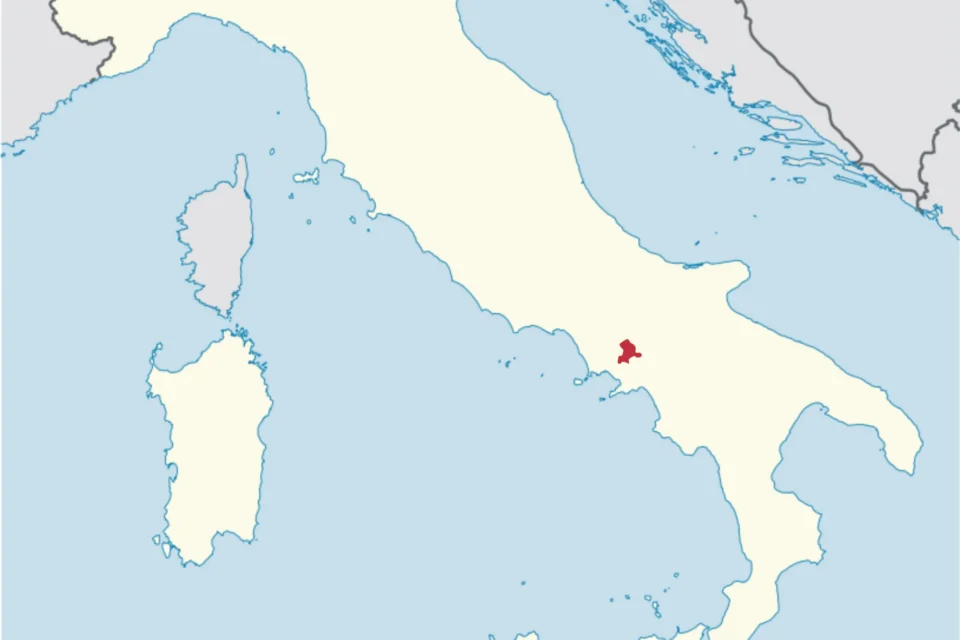
Sant’Agata de’ Goti lies roughly halfway between Naples and Benevento, reachable by car in about forty minutes from either, with regional rail and bus links from Benevento and Caserta along the valley. The historic centre is compact but stepped; comfortable shoes matter on the stone lanes. Churches generally open in the morning and late afternoon, while the castle and museum openings vary with the season and cultural events — the municipal tourist information office in town can confirm times, and the comune’s website lists current openings. Combine the town with the vineyards of the Sannio hills or with Benevento itself, and consider visiting outside August, when the tuff radiates heat.
Nearby places
Benevento, the provincial capital some twenty-five kilometres east, holds the Roman Arch of Trajan and the Lombard church of Santa Sofia, both UNESCO-listed. Closer still, Montesarchio guards the Caudine valley beneath its fortress and tower, on the road you would take towards Naples.
Worth building a day around.
Castello ducale di Sant'Agata de' Goti
Access confirmed via access_source_id (see referenced source). Hilltop tuff borgo with steps and narrow lanes; limited accessibility.
Cattedrale di Santa Maria Assunta
Access confirmed via access_source_id (see referenced source). Hilltop tuff borgo with steps and narrow lanes; limited accessibility.
Chiesa dell'Annunziata
Access confirmed via access_source_id (see referenced source). Hilltop tuff borgo with steps and narrow lanes; limited accessibility.
Chiesa di San Menna
Access confirmed via access_source_id (see referenced source). Hilltop tuff borgo with steps and narrow lanes; limited accessibility.
Chiesa di Sant'Angelo de' Munculanis
Access confirmed via access_source_id (see referenced source). Hilltop tuff borgo with steps and narrow lanes; limited accessibility.
Chiesa di Santa Maria di Costantinopoli
Access confirmed via access_source_id (see referenced source). Hilltop tuff borgo with steps and narrow lanes; limited accessibility.
Chiesa e convento di San Francesco
Access confirmed via access_source_id (see referenced source). Hilltop tuff borgo with steps and narrow lanes; limited accessibility.
Palazzo Mustilli
Access confirmed via access_source_id (see referenced source). Hilltop tuff borgo with steps and narrow lanes; limited accessibility.
Ponte Martorano
Access confirmed via access_source_id (see referenced source). Hilltop tuff borgo with steps and narrow lanes; limited accessibility.
Journeys in Sant’Agata de’ Goti.
Demo — Sant'Agata de' Goti Private Highlights Tour
Let a local expert design your Sant’Agata de’ Goti day.
Tell us your dates and pace. A travel designer replies within one working day.