Crete Senesi
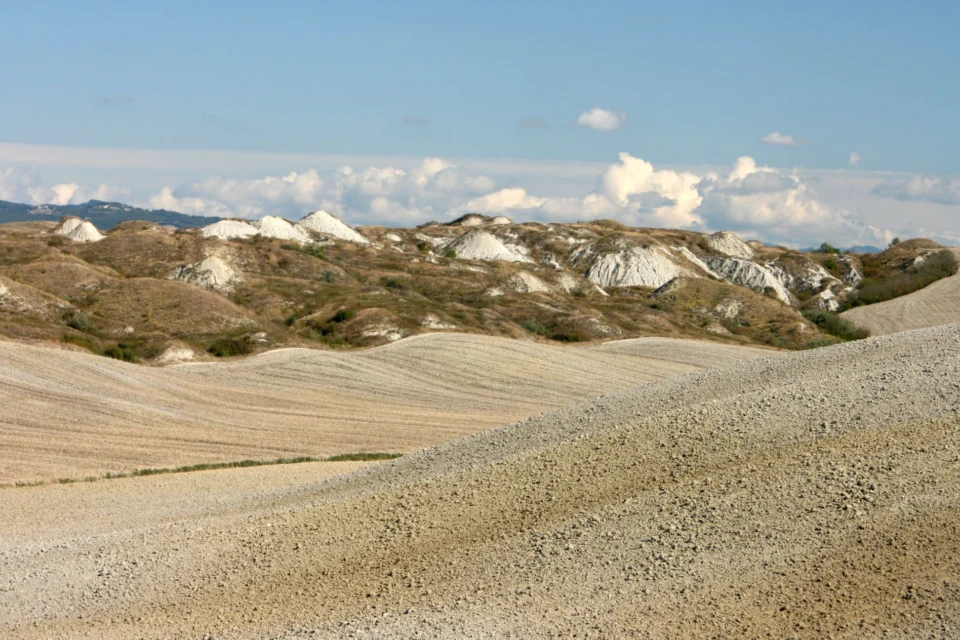
South-east of Siena the land turns to sculpture: the Crete Senesi are waves of naked clay hills, eroded into the pale mounds called biancane and the sharp gullies of calanchi. Within this lunar-seeming landscape lie the Olivetan abbey of Monte Oliveto Maggiore, the museum town of Asciano, Etruscan digs and truffle woods — one of Tuscany’s strangest and most rewarding territories.
Why visit
The Crete Senesi are visited for the country as much as for what stands in it. The clay soil that makes farming hard makes the scenery extraordinary: treeless ridges, folds and eroded cones that change colour with the seasons, from winter grey to the high gold of summer harvest. Threaded through this emptiness are remarkable destinations — a monastic mother house whose cloister frescoes rank among the Renaissance’s great cycles, small museums of archaeology and sacred art in medieval palaces, a fortified grange of Siena’s hospital, and truffle country in the hills around San Giovanni d’Asso. Because the area sees a fraction of the traffic of the Val d’Orcia beside it, travellers find viewpoints, abbeys and village tables without queues. Cyclists and slow-road drivers consider these roads among the finest in Tuscany.
Character and history
The landscape is the history. Centuries of run-off on the Pliocene clay cut the biancane and calanchi and made arable farming risky, so settlement gathered in pievi, castles and fortified farm complexes, while Siena extended its control over the area in the Middle Ages. Religious order shaped it too: from Asciano’s native son San Bernardo Tolomei came the Olivetan congregation, founded in the early fourteenth century, whose mother abbey at Monte Oliveto Maggiore became one of the great spiritual and artistic centres of Tuscany. The Republic of Siena imposed its own infrastructure on the clay, building the fortified grange where pilgrims and freight rested on the southern roads — the Grancia di Cuna remains its most complete survivor. Asciano grew as the area’s market and service town, accumulating a palatial museum home at Palazzo Corboli; villages like Buonconvento and Murlo keep collections that document Etruscan aristocrats who held these hills long before Siena. Modern times added truffle woods and, in the Life Park, formal protection of the countryside that postcards made famous.
What to see
Anchor the journey on the Abbey of Monte Oliveto Maggiore, the Olivetan motherhouse founded by San Bernardo Tolomei in the early fourteenth century, where the great cloister carries fresco cycles by Luca Signorelli and Sodoma and the monastic community still sings the liturgy. In Asciano, the Palazzo Corboli Civic Archaeological and Sacred Art Museum combines fourteenth-century frescoed halls with works by Ambrogio Lorenzetti and Etruscan finds from the Ombrone valley, while the Basilica of Sant’Agata serves as the town’s mother church. At Buonconvento, the Museum of Sacred Art of the Val d’Arbia gathers diocesan painting in a historic palazzo, and at Murlo the Archaeological Museum of Murlo (Poggio Civitate Antiquarium) displays finds from one of Etruscology’s most important excavations. South in the Ombrone hills, the Truffle Museum explores the area’s tuber culture inside San Giovanni d’Asso’s castle, and out in the fields the Grancia di Cuna (fortified farm complex) preserves Siena’s medieval agro-architecture at its most sculptural.
How to experience
Travel the Crete the way its shapes demand: slowly, with stops. Base yourself in Asciano or Buonconvento and drive the white and secondary roads in morning light, when shadows model the biancane; pull over at viewpoints rather than driving and gawking. The abbey rewards timing — visiting around the monks’ liturgy lets you hear Gregorian chant in the space built for it. Cyclists find the ridge roads between Asciano, Chiusure and Monte Oliveto among the region’s classic rides, with long views and little traffic. In autumn, the truffle season brings fairs and menus built on the local tuber; the museum at San Giovanni d’Asso explains what you are eating. Book tastings and check excavation-site access ahead, since small museums keep short seasonal hours.
Practical planning
The Crete begin about ten kilometres south-east of Siena and are best explored by car; train service reaches Asciano on the Siena line, but the abbey, grange and villages require road travel. Roads are narrow, uninsured gravel in places, and viewpoints sit on blind crests — drive with patience. Summer heat is intense across the bare hills; carry water and plan indoor museums for midday. Hours at the abbeys and museums shift with the season and some close weekdays in winter, so confirm current schedules locally. Spring brings green ridges and long sightlines, autumn the harvest and truffle fairs; both are ideal, and accommodation in farmhouses books early for those windows.
Nearby places
The area shades into the Val d’Orcia to the south, with San Quirico d’Orcia and Bagno Vignoni beyond, while the hill towns of Montepulciano, Pienza and Montalcino ring the southern edge. To the north-west lies Colle di Val d’Elsa on the road toward Volterra.
Worth building a day around.
Abbazia di Monte Oliveto Maggiore
Official abbey website (opened and read: homepage and Visite page) lists the visitable spaces and visitor contacts; the Museo dell'Abbazia is listed by the…
Basilica di Sant'Agata
Official parish website (opened and read) documents history, artworks and status; also named by Fondazione Musei Senesi among Asciano's principal monuments. Asciano's mother church…
Grancia di Cuna
Visit Tuscany official page (opened and read) documents the complex, its history and location; the site is a registered FAI 'Luogo del Cuore' with…
Museo Archeologico di Murlo (Antiquarium di Poggio Civitate)
Official Comune di Murlo museum page (opened and read, managed with Fondazione Musei Senesi) provides hours, prices, contacts and status. Etruscan museum in the…
Museo Civico Archeologico e d'Arte Sacra di Palazzo Corboli
Fondazione Musei Senesi official page (opened and read) provides full hours, ticket table, collection and contacts (managed with Comune di Asciano). 13th-century palatium (c.…
Museo d'Arte Sacra della Val d'Arbia
Fondazione Musei Senesi official page (opened and read) gives hours, tickets and collection; museum site artesacra.museibuonconvento.com exists. Founded 1926 in Palazzo Ricci Socini; Sienese…
Museo del Tartufo
Fondazione Musei Senesi official page (opened and read) states location, ticketing, sections and the current temporary closure for renovation. Italy's first truffle museum, in…
Journeys in Crete Senesi.
Demo — Crete Senesi Private Highlights Tour
Let a local expert design your Crete Senesi day.
Tell us your dates and pace. A travel designer replies within one working day.