Bolgheri
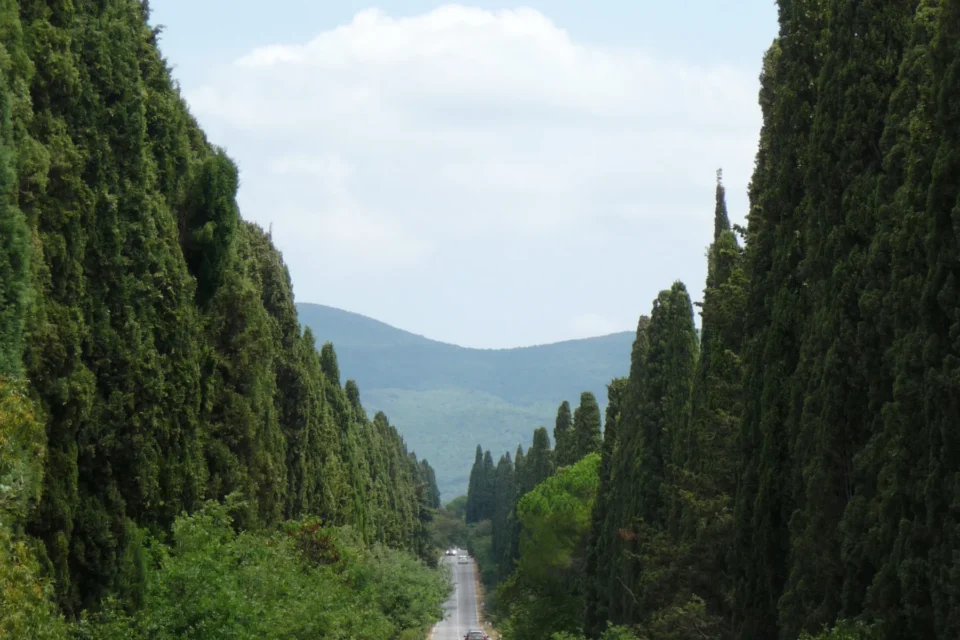
Bolgheri sits where the Etruscan Coast’s hills meet the sea, a medieval borgo approached down five kilometres of cypresses made famous by Carducci’s verse. Around it stretches one of Italy’s most consequential wine territories, home to the Super Tuscans that rewrote the country’s winemaking in a single generation.
Why visit
Few places in Tuscany fuse literature, landscape, and wine so completely. The approach alone is the stuff of schoolbooks: a perfectly straight avenue of ancient cypresses, planted in double rows from San Guido to the village gate, immortalised by Giosuè Carducci in his poem Davanti a San Guido. Inside the walls, the borgo is small and romantic — stone palazzi, geranium-draped lanes, and a castle still owned by the family that has held it for centuries. Outside, the vineyards of Bolgheri DOC produce some of Italy’s most collected wines. Visit for a slow afternoon of tasting, an evening stroll, and the easy rhythm of the Etruscan Coast.
Character and history
The village grew around its medieval castle on the edge of the coastal plain below Castagneto Carducci, seat of the powerful Della Gherardesca family, whose descendants still own the castle and whose forebear Count Guido Alberto planted the famous avenue in the nineteenth century — Visit Tuscany counts some 2,540 cypresses along its five-kilometre run. The young Carducci lived here, where his father worked for the family, and the poem he later wrote fixed Bolgheri in the Italian imagination; an obelisk honouring the poet, erected in 1908, marks the start of the avenue beside the Oratory of San Guido, the hexagonal chapel the family commissioned along the Via Aurelia. The twentieth century brought the vine revolution: international varieties — Cabernet Sauvignon, Merlot, Petit Verdot — planted in the dry, sunny coastal microclimate produced Sassicaia, Ornellaia, and Masseto, the wines that became known simply as the Super Tuscans.
What to see
Begin at the Cypress Avenue of Bolgheri, driving or cycling its tunnel of trees from the Oratory of San Guido, then walk the borgo: the castle rising over the village, the little churches of Sant’Antonio and San Giacomo e San Cristoforo, and Piazza della Vittoria, the tiny cobbled square at the heart of the village with its cafés and wine shops. Poets’ trailgoers can find Carducci’s childhood memory markers nearby in Castagneto Carducci, and the Padule di Bolgheri wetland, Italy’s first private nature reserve, draws birders between the village and the sea.
How to experience
Taste methodically. The village’s enoteche and the estates along the Strada del Vino pour Bolgheri DOC and DOCG reds, and booking a cellar visit ahead of the afternoon is the single best use of time here. Walk or ride the avenue rather than only driving it — the perspective changes completely at bicycle pace, and vintage-cycling fans gather each April for L’Etrusca Ciclostorica. September brings Bolgheri Jazz, pairing concerts with the wineries. Eat on a terrace under the castle walls: coastal Maremma cooking, wild boar, and the local reds. Sunset from the avenue, looking back toward the hills, is the moment photographers wait for.
The village rewards slowness more than stamina. Two hours cover every lane, so the trick is to stretch them: a coffee in the square, a climb to the castle viewpoint, a stop in the churches, then a gradual retreat along the cypresses with the windows down. Birdwatchers diverge to the Padule, where a boardwalk crosses the wetland between the borgo and the sea; beachgoers drop to the pine-backed shore ten minutes away. Even in August, when the avenue’s parking fills by late morning, the borgo’s walls stay cool and the evenings belong to the wine bars.
Practical planning
Bolgheri lies a few kilometres inland from the Aurelia coast road between Livorno and Piombino, roughly an hour from Pisa airport by car. The village is pedestrian; park at the entrances and walk in through the gate by the castle. Tastings and cellar visits nearly always require advance booking, and the famous estates open by appointment only, so plan the wine itinerary before arrival. Summer evenings are the busiest and most atmospheric hours; spring offers green vines and cooler walking. Combine with Castagneto Carducci above the hill, the beach strip at Marina di Castagneto, or a day toward Baratti and Populonia’s Etruscan shore.
Nearby places
Castagneto Carducci, the hilltown that shares Bolgheri’s municipality and its Carducci heritage, sits minutes away, while the Etruscan coast continues toward the gulf of Baratti, the island of Elba offshore, and the port city of Livorno to the north.
Worth building a day around.
Castello di Bolgheri
Visit Tuscany, in “Bolgheri: a hidden gem along the Etruscan Coast”, identifies Castello di Bolgheri as a visitor-relevant attraction associated with Bolgheri. Verified source…
Oratorio di San Guido
Visit Tuscany (portale turistico regionale ufficiale), in “The Cypress Avenue of Bolgheri”, identifies Oratorio di San Guido as a visitor-relevant attraction associated with Bolgheri.…
Piazza della Vittoria
Visit Tuscany, in “Bolgheri destination page”, identifies Piazza della Vittoria as a visitor-relevant attraction associated with Bolgheri. Verified source scope: Bolgheri borgo; Carducci childhood…
Viale dei Cipressi
Visit Tuscany (portale turistico regionale ufficiale), in “The Cypress Avenue of Bolgheri”, identifies Viale dei Cipressi as a visitor-relevant attraction associated with Bolgheri. Verified…
Journeys in Bolgheri.
Demo — Bolgheri Private Highlights Tour
Let a local expert design your Bolgheri day.
Tell us your dates and pace. A travel designer replies within one working day.