Montagnana
Montagnana stands in the flat western reaches of Padua province behind one of Europe’s most complete medieval wall circuits: nearly two kilometres of crenellated masonry, twenty-four towers and four gates enclosing a whole inhabited town. Inside are a Gothic duomo, a Palladio villa and the homeland of a prized cured ham — a walled town that still lives at medieval scale.
Why visit
Few places in Europe let you walk an unbroken fourteenth-century wall circuit around a living town; Montagnana is the Veneto’s benchmark. The walls are not a fragment or a reconstruction but a functioning perimeter with towers you can climb, gates aligned to the cardinal points, and a moated setting that still reads clearly in the surrounding fields. Inside, the pace is village-quiet: porticoed houses around Piazza Vittorio Emanuele II, a late-Gothic cathedral, cafés and workshops filling the blocks between the towers. The town rewards two kinds of traveller equally — the military-architecture enthusiast, who will find Castel San Zeno and the Rocca degli Alberi as an intact pair of gate-castles, and the slow traveller, who can cycle the Euganean-Berico countryside, eat the local Prosciutto Veneto Berico-Euganeo at source, and end the day watching swallows circle the battlements. Its position midway between Padua, Vicenza and Verona makes it an easy, uncrowded full-day excursion from any of the three.
Character and history
Fortification is Montagnana’s biography. Late-antique settlers raised earthworks against invasion; by the eleventh century documents record the castrum’s walls under communal maintenance. In 1242 Ezzelino III da Romano burned the town, then rebuilt it more strongly, raising the keep that still bears his name. The decisive construction came in the mid-fourteenth century under the Carraresi of Padua, who threw up the present circuit against their Scaliger rivals: brick and Euganean trachyte, Guelph merlons, twenty-four perimeter towers around eighteen metres high, and a wide moat fed by the Frassine through the fortified canal called the Fiumicello. The two original entrances faced Padua in the east and Verona in the west, each shielded by its own castle — the Castel San Zeno with the Mastio di Ezzelino, and the Rocca degli Alberi. Venetian rule from the fifteenth century drained the frontier’s urgency; the Porta Nova was added in the sixteenth toward the Frassine landing, and the nineteenth century cut Porta XX Settembre toward the new railway. Modern Montagnana trades on the inheritance carefully: restoration campaigns directed by the state heritage authority run along the walls, and the walled fields beyond support the prosciutto cure that gives the town its second fame.
What to see
Begin at the walls themselves — the Montagnana Medieval Walls can be walked on foot outside and entered at several points, with information panels tracing the Carrarese building campaign. Climb Castel San Zeno, the eastern gate-castle, where the Mastio di Ezzelino offers a panoramic terrace and the castle rooms house the Civic Archaeological Museum “A. Giacomelli”, a collection that ranges from the territory’s ancient past to opera memorabilia — the tenor Aureliano Pertile was born here. At the opposite corner stands the Rocca degli Alberi, the western twin guarding the road to Verona. The Duomo of Santa Maria Assunta holds the old town’s artistic centre, its late Gothic-Renaissance interior enriched by works including a fresco cycle by Giovanni Buonconsiglio. The fourteenth-century Church of San Francesco survives in its conventual quiet at the town’s edge. Just outside the walls, Villa Pisani (Placco) adds Andrea Palladio to the itinerary — a compact villa from the master’s late career and part of the UNESCO Palladian serial site. The eastward Porta Padova and the porticoed Piazza Vittorio Emanuele II complete the circuit.
How to experience
Walk or ride the full wall circuit first: outside, the moat line and tower spacing give the full defensive logic; inside, the town unrolls in short lanes between green spaces. Rent bicycles to reach Villa Pisani and the surrounding fields, where the flat roads of the Berica-Euganea plain are ideal for easy touring. Plan a lunch around the town’s prosciutto — cut paper-thin with bread and local wine — and visit in the week of the Palio dei 10 Comuni each September, when the four quarters contest a horse race inside the walls and the town returns, briefly, to a medieval crowd. Birdwatchers should look up in spring and autumn: swifts and swallows nest in the towers. Photography is best in early morning, when the east-facing Porta Padova catches sun and mist burns off the moat line, and at dusk from the Rocca degli Alberi side. Allow half a day minimum; a full day with the villa, museums and a long lunch is more realistic.
Practical planning
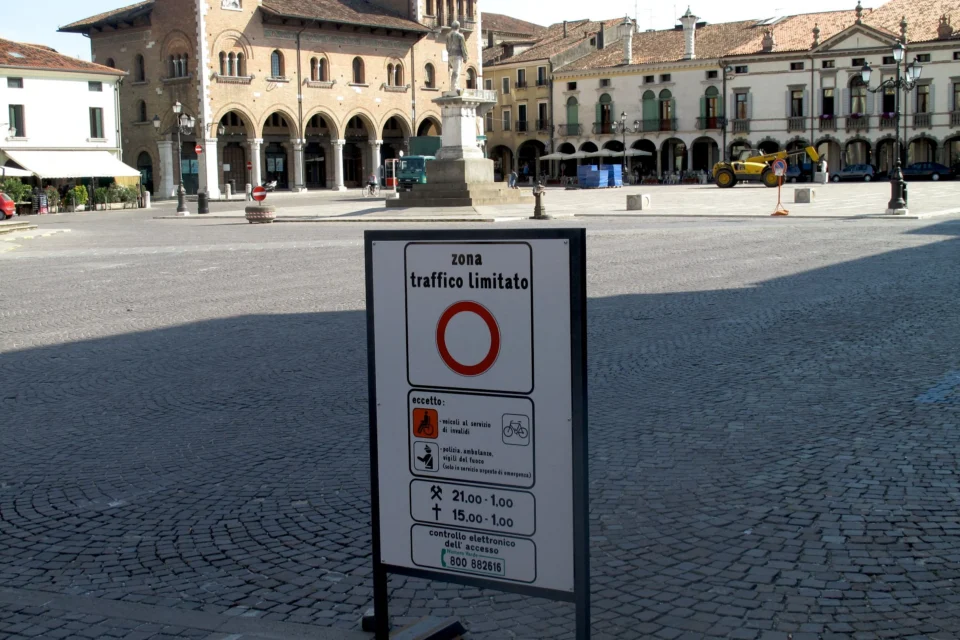
Montagnana lies about forty minutes south-west of Padua by car and is served by regional buses from Padua, Vicenza and Este; the railway station sits just outside Porta XX Settembre on the Padua–Mantua line. Parking is straightforward in signed areas outside the gates; the walled interior is pedestrian-friendly but not closed to residents’ cars, so walk the lanes attentively. Wall access, castle and museum openings vary by season and around restoration works — the state heritage authority is running a multi-year programme on the northern stretch — so check current access on the town’s official tourism site before travelling. The September Palio and the prosciutto fairs concentrate visitors; book rooms early for those weekends. Accommodation includes in-town guesthouses and countryside agriturismi. Spring and autumn are ideal; summer afternoons on the plain are hot, and the walls offer little shade — carry water and save the ramparts for the cooler hours.
Nearby places
- Cittadella — Paduan bastioned town whose elliptical wall circuit offers a walkable parapet, a natural pairing with Montagnana.
- Arquà Petrarca — Petrarch’s hill village in the Euganean Hills, south-east across the plain.
- Este — castle town of the Este dynasty at the Euganean foot, with its own civic museums.
Worth building a day around.
Castel San Zeno
Official operator page (Murabilia) publishes guided visit times, museum hours and tickets; castle houses the Museo Civico Archeologico A. Giacomelli and the Mastio di…
Chiesa di San Francesco
Listed in the CEI BeWeB diocesan register of worship buildings; guided visits documented in the town's cultural programme (Murabilia events) Guided visits organised by…
Duomo di Santa Maria Assunta
Colli Euganei tourism portal documents the duomo built 1431-1502 (Cristoforo da Bolzano, Lorenzo da Bologna) with frescoes attributed to Giorgione, Buonconsiglio's Assunzione, Veronese's Trasfigurazione…
Mastio di Ezzelino
Official operator page: keep open to visitors with EUR 2 single ticket, panoramic access during opening hours Tallest and oldest tower of the city,…
Mura di Montagnana
Soprintendenza PD-VE page documents the wall circuit restored by the state heritage office; Colli Euganei tourism portal describes the circuit of 24 hexagonal towers…
Museo Civico Archeologico "A. Giacomelli"
Official operator page: museum inside Castel San Zeno with Roman necropolis of the Gens Vassidia (14 tomb assemblages of ancient glass) and memorabilia of…
Piazza Vittorio Emanuele II e il borgo murato
Featured on the official tourism portal and Colli Euganei portal as the heart of the walled town; the town holds Bandiera Arancione recognition Public…
Porta Nova (Porta di Vicenza)
Colli Euganei portal: Porta Nova/di Vicenza opened in the Cinquecento on the north side toward the Frassine river landing Street-level gate passage, freely accessible
Porta Padova
Murabilia page situates the gate in the town wall circuit at Borgo San Zeno ('a pochi passi da Porta Padova'); gate is part of…
Porta XX Settembre
Colli Euganei portal: Porta XX Settembre added in the Ottocento on the south side toward the railway station Street-level gate passage, freely accessible
Rocca degli Alberi
Colli Euganei tourism portal and Soprintendenza documentation identify the Rocca degli Alberi as the western (Verona/Legnago) fortified access of the wall circuit Imposing exterior…
Villa Pisani detta Placco
Villa designed by Andrea Palladio (1552, built 1553-1555); UNESCO 'City of Vicenza and the Palladian Villas of the Veneto' component; Palladian UNESCO Heritage portal…
Journeys in Montagnana.
Demo — Montagnana Private Highlights Tour
Let a local expert design your Montagnana day.
Tell us your dates and pace. A travel designer replies within one working day.